
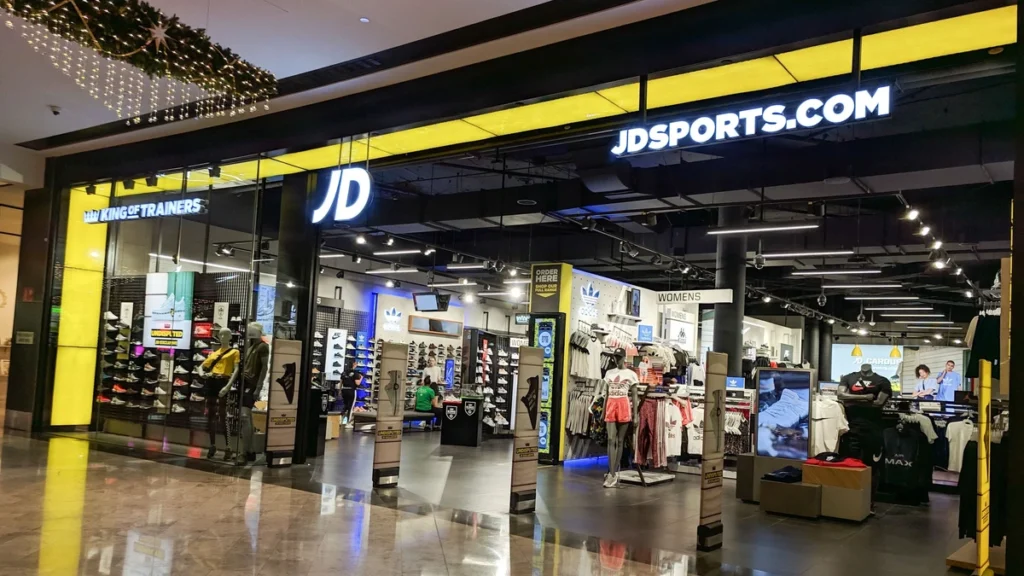
JD Sports cut its full-year profit guidance on 20 August, and the cut is not the most interesting thing in the statement. The group now expects profit before tax and adjusting items of £700m to £800m, down from £750m to £850m. Set against the £852m it reported on the same measure for the financial year just ended, even the top of the new range is a decline, and the bottom of it is a fall of roughly 18%.
The reason sits in a segment table where the three parts of the business moved in three directions at once. Complementary athleisure sales fell 8.0% on an organic basis. Sporting goods and outdoor rose 6.4%. The core JD fascia, much the largest of the three, was close to flat. A retailer can absorb a soft quarter. What is harder to plan around is a quarter in which its own categories diverge by fourteen percentage points, because that is a demand signal rather than a weather one.
Fourteen Points Between the Best and Worst Segment
The quarter ran thirteen weeks to 1 August 2026. Group organic sales fell 1.3% and like-for-like sales fell 3.1%, on total sales of £3,088m, according to the company’s second-quarter trading statement.
Complementary athleisure, the branded apparel and lifestyle end of the range, turned over £699m with organic sales down 8.0% and like-for-like down 7.9%. The near-identical figures matter. When organic and like-for-like fall together by the same amount, new space is not masking anything: the decline is in the stores that were already trading.
Sporting goods and outdoor went the other way, on £409m of sales, with organic growth of 6.4% and like-for-like growth of 5.0%. It is the smallest of the three segments and the only one growing on both measures.
The JD fascia itself took £1,980m, organic sales down 0.3% and like-for-like down 2.8%. Strip out Finish Line, the US chain the group has been restructuring, and the same segment grew 1.9% organically. That single adjustment reframes the quarter: the core business was not shrinking so much as carrying something that was.
What “End-of-Cycle Footwear” Means
The statement’s own explanation is a phrase worth reading twice. Footwear “remained soft given consumer pressures and ongoing product cycle evolution across key brand partners”, with “ongoing softness in end-of-cycle footwear product lines”.
Translated, a trainer retailer’s sales depend less on how much customers want trainers than on where its suppliers happen to be in their design cycles. A silhouette that has been in market for three or four seasons sells at a discount to clear. Its replacement has not yet reached the volume that carries a whole quarter. JD is a distributor of other companies’ product cycles, and it does not control their timing. That is a structural feature of the model rather than a one-off.
The reading is supported by what did work. The statement credits “continued momentum in the performance-based running category and newer footwear styles” as a partial offset. Running is performance rather than lifestyle, bought for a purpose instead of a look, and it is the part of the range least exposed to whether a particular retro model is fashionable this year. That is also, roughly, the boundary between the segment that fell 8% and the segment that rose 6%.
North America Took the Sharpest Hit
By region, North America was the weak point: organic sales down 4.5%, like-for-like down 6.8%, on £1,070m. Excluding Finish Line the organic decline narrows to 1.0%, which places most of the regional shortfall in one chain rather than in the American consumer.
Régis Schultz, the chief executive, was direct about the backdrop. “Trading in the second quarter remained tough. The market stayed highly promotional,” he said, adding that “North America saw the most acute impact, also reflecting a slower quarter for high-heat footwear product and the timing of ‘back-to-school’ demand.”
Those two explanations have different lifespans. Back-to-school timing is a shift between quarters and should reverse in the next one. A promotional market does not reverse on its own, because no individual retailer can stop discounting while its competitors are still doing it.
The UK Was the Only Region Growing on Like-for-Like
Europe fell 0.4% organically and 2.7% like-for-like on £1,062m. Asia Pacific grew 10.2% organically but only 1.4% like-for-like on £152m, which is mostly new space rather than existing stores trading better.
The UK was the outlier. Organic sales were down 0.2%, effectively flat, but like-for-like sales rose 0.8% on £804m. It was the only region in the group where the existing estate sold more than it had a year earlier. In a quarter this soft that is the most encouraging line in the table, and it is easy to miss because the organic figure printed next to it is fractionally negative.
A domestic market outperforming the international ones is not the shape most UK retailers are reporting at the moment. Next’s overseas growth ran at seven times its UK online rate in its own recent update, which is close to the opposite pattern. One quarter does not establish a trend in either case, but the divergence is worth tracking across the sector.
Cash Held, and the Buyback Kept Running
Guidance for free cash flow was left unchanged at £460m to £520m, against £462m delivered last year. That is the detail a shareholder should register: the profit range came down and the cash range did not.
The group ended the quarter in a net cash position and began the second £100m tranche of its £200m buyback on 3 August. Online sales grew 2.6%. Space growth contributed 2.1% to sales in the first half despite a lower store count, so the estate is being edited rather than simply expanded. It now runs to 4,766 stores across 35 countries, of which 145 are standalone Finish Line, 104 are JD Gyms and 83 are franchised.
A company that cuts profit guidance while holding cash guidance and continuing to buy its own shares is describing a margin problem rather than a solvency one. Promotional trading costs gross margin. It does not necessarily consume working capital, and the distinction is the difference between a difficult year and a dangerous one.
The Promotional Market Was Not Only JD’s Problem
Official figures published the following day put the quarter in context. The Office for National Statistics reported that retail sales volumes fell 0.5% in July, after a rise in June, with non-food stores and non-store retailers falling back. Retailers attributed the drop to demand having been pulled forward into June by earlier-than-usual promotional activity.
That is the same mechanism Schultz described, seen from the other side of the till. Discounting in June borrowed sales from July. The three-month picture still rose 1.1% against the three months to April, and 3.0% year on year, so the underlying consumer was not collapsing. The monthly path was distorted by promotion rather than by demand disappearing.
One correction is owed here. The June rise we reported at 1.0% has since been revised down by the ONS to 0.7%, while May was revised up from 1.2% to 1.3%. Revisions of that size are routine in the monthly series, and they are a standing reason to treat any single month’s retail figure as provisional.
What to Watch on 23 September
JD reports next on 23 September. Three things in this statement will either have moved by then or they will not.
The first is whether sporting goods and outdoor keeps growing at mid-single digits. If it does, it stops being a small division having a good quarter and starts being a genuine hedge against the fashion cycle. The second is whether the UK like-for-like figure stays positive, which would suggest the home market has found a floor ahead of the rest of the group. The third is Finish Line, which accounts for most of the North American gap and is the one variable substantially inside the company’s own control.
Schultz framed the guidance cut as “a pragmatic view of external market conditions”. That is a fair description of a range set below last year’s outturn in a market that is discounting heavily. It is also a concession that the recovery is not being forecast for this financial year.
About The Author




More Stories
LearnUpon Secured $50m Without Selling a Single Share
La Cordée Is Closing With $13 Million Owed and 210 Jobs Lost
Pensioners Would Carry Half the Private Health Insurance Rebate Cut