
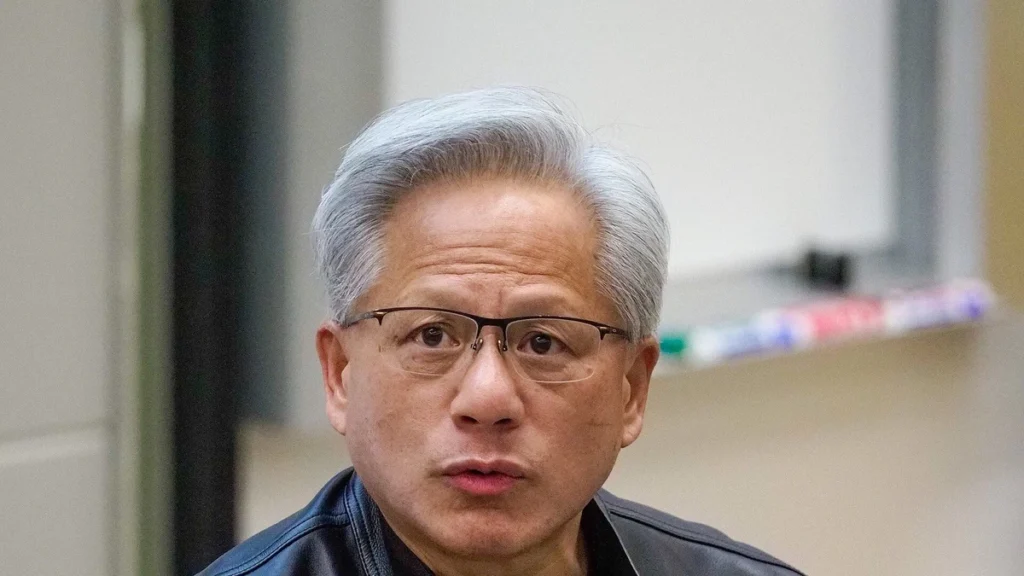
Nvidia’s board chair opened the company’s earnings call on Tuesday by closing a door. Harvey Jones told analysts the board had unanimously accepted Jensen Huang’s resignation and “does not intend to reinstate Jensen as CEO”, hours after Huang said in a statement that he would be “honored” to return. Then the numbers arrived: revenue of $115.8 billion for the quarter to 25 October, up 103% on a year earlier.
For businesses that buy, resell or build on Nvidia’s chips, which now includes most of the world’s large cloud providers, the results settled one question and left another open. Demand has not slowed. Who will lead the company that supplies it, and when a permanent chief executive will arrive, is still unresolved. This was the first full look at Nvidia without Jensen Huang, the co-founder who ran it for 33 years.
What Nvidia Reported for the Quarter
Nvidia’s financial year does not follow the calendar, so the three months to 25 October were the third quarter of its 2027 fiscal year. Revenue rose 20% from the previous quarter, according to the results filing. Data centre revenue, the chips and systems sold to cloud companies and AI developers, reached $107.6 billion, up 110% year on year. Gross margin, the share of revenue left after the direct cost of making products, was 74.8% under standard US accounting rules (GAAP) and 74.9% on the adjusted basis the company also reports.
Net income under GAAP was $65.3 billion, and earnings per diluted share were $2.70, or $2.68 on the adjusted basis. CNN reported that both revenue and profit more than doubled from a year earlier and beat Wall Street’s expectations. Edge computing, the smaller division that includes gaming, PCs and automotive technology, brought in $8.2 billion, up 42% on the year.
Cash is still flowing back to shareholders. Nvidia returned $28.1 billion in the quarter through share buybacks and dividends, and had about $227.3 billion left under its repurchase authorisation after the board added $150 billion in September. Its next quarterly dividend, of $0.25 a share, is due on 23 December to shareholders on the register on 2 December.
Guidance of $130 Billion, With Nothing From China
The outlook matters more to customers than the quarter just gone. Nvidia expects fourth-quarter revenue of $130 billion, plus or minus 3%, in a period that includes an additional week. It is not assuming any data centre compute revenue from China in that forecast, which leaves the world’s second-largest economy out of its plan entirely.
Margins are expected to narrow. Nvidia guided gross margins of 71% to 72% for the fourth quarter, down from almost 75% in the third. Operating expenses are forecast at about $11 billion under GAAP. On the product side, the company said it had begun shipping Vera Rubin NVL72, its newest rack-scale computing system, in the fastest product ramp in its history, with racks already running at CoreWeave, Google Cloud, Microsoft Azure, Oracle Cloud Infrastructure and Nebius.
The board also used the results to respond to the security questions around Huang’s departure. CNN reported that Nvidia has set up a national security and export control oversight committee to make sure it is abiding by global trade regulations, and that it will strengthen its internal compliance work.
Why the Board Ruled Out Huang’s Return
Huang resigned as president, chief executive and a member of the board on 12 November, effective immediately, according to the company’s announcement. The board named Colette Kress, Nvidia’s chief financial officer since 2013, as interim chief executive while it searches for a permanent successor among internal and external candidates. It also appointed Harvey Jones, a former chief executive and executive chairman of the chip-design software company Synopsys, as its first-ever chair.
CNN reported that Huang resigned amid national security concerns and reports of multiple extramarital affairs, and that the board opened an investigation into whether he had been the target of a foreign intelligence effort. Jones said on the call that he would not take further questions about the resignation or the investigation, and that the board would communicate further when appropriate.
Kress was just as direct in an interview with CNBC’s Jim Cramer. “The board has determined that they will not reinstate Jensen,” she said. On the call she told investors that Nvidia’s ambition, its passion to innovate and its commitment to customers, partners and shareholders would not change, and she closed with a line aimed as much at staff as at investors: “Our customers and our partners are with us. And employees are committed. We’ve got this.”
A Workforce and an Investor Base Still Divided
The decision has not ended the argument inside the company. CNBC reported that an online petition calling for Huang’s return had nearly 200,000 signatures, with more than 10,000 signatories claiming to be current Nvidia employees, out of a workforce of roughly 42,000. Outside the company, at least two major investors and technology figures including Elon Musk, Y Combinator chief executive Garry Tan and Epic Games chief executive Tim Sweeney have called for his reinstatement, and President Donald Trump said he “would not mind” seeing Huang return as chief executive, according to CNBC.
Kress told employees at an internal meeting on Monday that “This is a new era for Nvidia,” according to a person present who spoke to CNBC. On Wednesday she addressed the whole company at the all-hands meeting Nvidia traditionally holds the morning after each earnings call, joined by Jones and by Ian Buck, who runs the hyperscale and high-performance computing business. On the earnings call she said the remaining workers were “committed to doing their life’s work at Nvidia.”
For a company whose engineers were, in one former employee’s words to CNBC, “extremely devoted to him”, keeping senior technical staff is the practical challenge behind the headlines. Huang was known for his deep day-to-day involvement in the company’s operations, often responding directly to engineers, CNBC noted, which makes the transition as much an operational question as a governance one.
What the Share Price Has Already Absorbed
Investors had marked the company down well before the results. Nvidia shares had fallen 16.7% since Huang admitted to an extramarital affair and the board opened its investigation, erasing $751 billion in market value, and stood 35% below their 6 October record, a fall of roughly $2 trillion, CNN reported. The stock rose about 5% in after-hours trading on Tuesday once the results and the call were out.
Some analysts read the quarter as evidence that the business can run without its founder, at least for now. “The massive results, strong guidance and reassurance that the strategy Huang put in place remains firmly on track show that an orderly CEO transition does not necessarily have to dilute the company’s value,” Thomas Monteiro, senior analyst at Investing.com, said in commentary quoted by CNN. Before the report, Mark Malek, chief investment officer at Siebert Financial, wrote that it would be the “most important in the company’s history”, according to CNN.
What It Means for Customers and Suppliers
For businesses outside the US, the message in the filing is continuity. Nvidia said supply chain partners including Amkor Technology, IBIDEN, King Yuan Electronics, Samsung Electro-Mechanics, Siliconware Precision Industries and Unimicron are scaling manufacturing capacity to meet demand. It announced work with Australia’s data centre sector on a planned buildout of up to 2 gigawatts by 2027, and expanded partnerships with carmakers Mercedes-Benz and Volvo Cars on automated driving. It also agreed to acquire Hugging Face, the open platform where developers share AI models, a deal that touches the many companies that host or download models there.
The bigger uncertainty is direction rather than supply. CNN described Huang as the AI industry’s biggest cheerleader and dealmaker, and until a permanent chief executive is named, Kress is doing two jobs: running the company and remaining its chief financial officer. Nvidia has not given a timetable for the search. For a wider view of the economy that Nvidia’s biggest customers operate in, see our report that US GDP grew 3.4% but consumer spending stalled in September.
About The Author




More Stories
NZ Lawyers Want Fewer Friday Settlements After a Microsoft Outage
Irish Firms Must Now File Gender Pay Gap Reports on One State Portal
Canada Plans a Once-a-Year Tax Instalment for the Self-Employed