
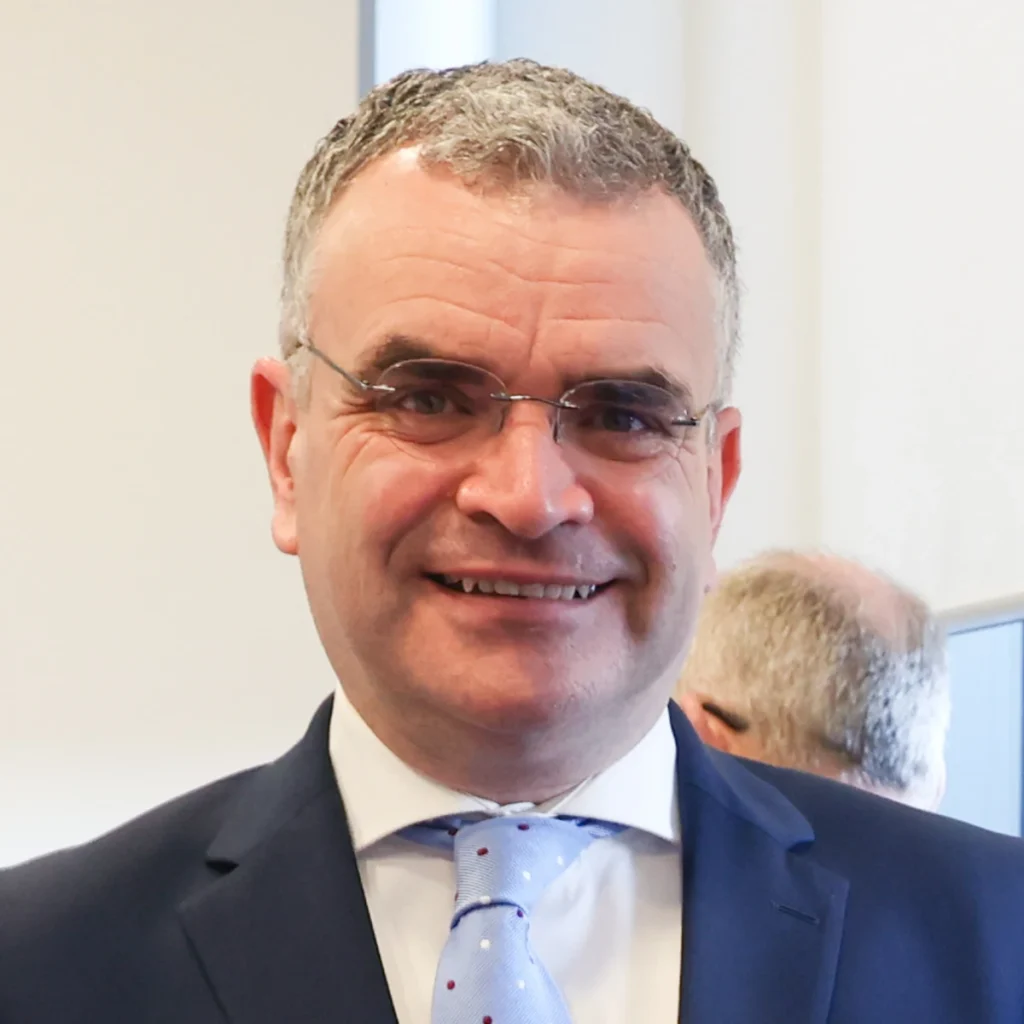
Minister for Social Protection Dara Calleary
Minister for Social Protection Dara Calleary
By the end of August, 29,352 workers had opted out of MyFutureFund, the auto-enrolment pension Ireland launched on 1 January. Set against a membership of more than 835,000 people, employed by about 115,000 businesses, that is fewer than 4 per cent of the scheme, according to figures the Minister for Social Protection, Dara Calleary, gave in replies to parliamentary questions reported by The Irish Times on 29 September.
The figure matters well beyond the Department of Social Protection. Every worker who stays in the auto-enrolment pension brings a matching employer contribution, currently 1.5 per cent of gross pay, and the published schedule doubles that rate in the scheme’s fourth year and quadruples it by the tenth. For the businesses now running MyFutureFund through their payroll, the first opt-out window was the first hard evidence of how much of that cost is going to stick.
What the First Opt-Out Window Showed
Membership of the scheme is compulsory for the first six months. Workers who were enrolled when it opened could leave during a two-month window that ran from 1 July to 31 August, and 29,352 chose to do so. The operator, the National Automatic Enrolment Retirement Savings Authority, known as NAERSA, said earlier this month that the total was below the number it had expected for the window, according to an earlier Irish Times report.
In a reply to Fianna Fáil TD John McGuinness (a TD is a member of the Dáil, the lower house of Ireland’s parliament), Calleary said the Irish opt-out rate was well below comparable schemes abroad, putting the rate at approximately 10 per cent in the United Kingdom and about 12 per cent in New Zealand. “The high numbers of participants and low opt-out rate demonstrate the great level of success that MyFutureFund has achieved since its commencement,” he said.
McGuinness welcomed the result as a good outcome and suggested that the people who withdrew should be interviewed, so the department can establish their reasons and see what might keep the momentum going. That is a sensible next step, because the headline rate compares leavers against the whole membership. Workers who joined after January can only opt out once they have been members for six months, so the count will keep moving as later joiners reach their own point of choice.
The money already in the scheme is substantial. By the end of August, NAERSA had collected €553 million for investment: €237 million in employee contributions, an identical €237 million from employers and €79 million from the State. Add €33 million in investment returns and the funds under investment stood at €586 million after eight months.
How MyFutureFund Works for Employers
For readers outside Ireland, MyFutureFund is the State’s attempt to close a long-standing gap in private pension coverage. According to Citizens Information, Ireland’s official public information service, an employee is enrolled automatically if they are aged between 23 and 60, earn €20,000 or more a year across all their jobs, and do not already pay into a pension through payroll. People outside those limits can choose to opt in, and about 10,500 did so in the first eight months, according to NAERSA.
The arithmetic is built to be simple. For every €3 a worker contributes, the employer adds €3 and the State adds €1, so each €3 from the employee becomes €7 in the pot. In the first three years the employee and the employer each pay 1.5 per cent of gross pay, with the State adding 0.5 per cent. Employer and State contributions stop once a worker’s salary reaches €80,000 in a year, which caps the employer’s exposure on higher earners.
The administrative load on employers was deliberately kept light. The Department of Social Protection has said the scheme is fully integrated with payroll systems, so a business does not need to set up a scheme of its own, engage pension advisers, appoint trustees or pay an administration fee. The savings belong to the worker and move with them from job to job, under what the department calls the “pot follows the member” approach, so a worker who changes jobs does not have to join a new scheme or pay transfer fees.
The simplicity comes with enforcement. Citizens Information notes that employers who do not meet their auto-enrolment obligations face penalties including fines and prosecution, and that an employer who fails to make contributions may be fined and required to repay them with interest.
Who Opted Out and What They Got Back
Workers who left recovered their own 1.5 per cent contributions, but the employer and State money stays invested in their pot. Calleary said the authority had “processed more than 30,000 refunds with a value of over €10 million to date, including refunds to participants who have opted out of MyFutureFund”. The average refund paid to an employee was €331, while an average of €400 was left behind in their fund.
That €400 is the part of the decision the authority urged workers to weigh before leaving. “By opting out, employees will forgo contributions from their employer, currently 1.5% of gross pay, and the State top‑up, which together significantly increases the value of each euro saved over time,” a NAERSA spokesperson told RTÉ News on the day the window opened.
Damien McCarthy of HR Buddy believes the leavers were mostly lower earners. “It has probably been primarily driven by people at the lower end of the earnings spectrum, people earning towards the €20,000 figure who simply need the money,” he told The Irish Times, adding that some of those who left would have private pension arrangements of their own. The profile matters most for employers whose staff earn close to the €20,000 threshold, where the 1.5 per cent deduction is felt most directly in take-home pay.
Not everyone who wanted a break chose to leave. According to NAERSA, 380 members asked to suspend their contributions instead, which keeps the money already saved invested and allows payments to restart later, and anyone who does leave is automatically re-enrolled after two years if they are still eligible.
The Employer Rate Doubles in the Fourth Year
The 1.5 per cent rate is only the opening stage. The schedule published by Citizens Information raises employee and employer contributions to 3 per cent in years four to six, 4.5 per cent in years seven to nine and 6 per cent from year ten onward, while the State’s share rises from 0.5 per cent to 2 per cent. Because the scheme started in 2026, the first step up lands in 2029 and the full rate arrives in 2035.
For a single worker on €20,000 a year, Citizens Information puts the employer’s annual cost at €300 in years one to three, €600 in years four to six, €900 in years seven to nine and €1,200 from year ten. As an illustration, a business with 30 staff on €40,000 each pays €18,000 a year in employer contributions at today’s rate, €36,000 once the rate reaches 3 per cent and €72,000 once it reaches 6 per cent, before any pay rises are counted.
Those numbers are why the opt-out rate is a planning figure and not only a policy scorecard. With roughly 96 per cent of members staying in, an employer can reasonably budget on nearly every eligible worker remaining enrolled, with the matching cost stepping up every three years alongside them. A finance team that has priced in only the current 1.5 per cent is looking at a cost line that has already been scheduled to rise fourfold.
Where Small Firms Say the System Is Slow
The first months have not been frictionless for every business. In a separate parliamentary question, Charles Ward, a TD for the 100% Redress Party, raised reports from employers of “significant delays in the processing and reimbursement of payments due to businesses”, which he said were affecting cash flow at small and micro enterprises.
In reply, Calleary said the vast majority of refunds were processed within 15 days. The slower cases involve employers who believe they overpaid through a payroll error. “Each request must be assessed by an authorised officer,” he said, before any money can be taken back out of an employee’s pension pot, adding: “There are approximately 500 such refunds on hand at present.”
For a small business, that sequence has a practical meaning. An overpayment caused by a payroll mistake is cash that sits in an employee’s pension until an officer approves its return, so the cheapest route is to get the payroll set-up right at the start rather than to rely on a refund afterwards. For a firm with thin margins, even a few hundred euro held up for weeks is a working capital question, not an accounting footnote.
What Employers Are Actually Doing
The contribution totals show that matching is happening at scale: employers have paid in exactly as much as their staff, €237 million each by the end of August. For most businesses, auto-enrolment has become another line in the monthly payroll run rather than a separate pension project, which was the point of designing it around payroll in the first place.
Awareness is patchier. McCarthy said “quite a few employers” would not have been aware of the opt-out period, and that there “wasn’t nearly so much advertising about this aspect of the scheme as there had been around its launch”. For employers, that points to a practical job over the coming months: telling staff clearly when their own window opens, what they would give up by leaving, and when they would be brought back in automatically.
Unions are watching the minority that is not complying. Laura Bambrick, social policy officer at the Irish Congress of Trade Unions, called the low opt-out rate “a resounding signal of support” for the scheme, but pointed to documents released under Freedom of Information that she said showed bad practice by some employers. “Continuing to monitor compliance and strong enforcement of the Auto-Enrolment Act will be central to determining the success of My Future Fund,” she said.
What Comes Next for the Auto-Enrolment Pension
Three milestones shape the next phase. Workers who joined after January will keep reaching their own opt-out point six months after enrolment, so the number of leavers will rise in small steps. Those who left this summer will be automatically re-enrolled after two years if they are still eligible, which brings the first wave back in 2028. The first contribution increase follows in 2029, when employee and employer rates move from 1.5 to 3 per cent.
The Minister was also expected to update the Cabinet on the scheme on 29 September. For employers the matched pension cost now sits alongside other rising benefit costs, and DailyBusiness.News recently reported how employer health cover is climbing 10 per cent while Europe averages 8 per cent, another line in the same benefits budget.
The lesson from the first window is straightforward. Almost everyone who was enrolled in Ireland’s auto-enrolment pension stayed in it, the cost of keeping them there is scheduled to quadruple over a decade, and the practical risks for employers sit in payroll accuracy and in how clearly staff understand the choice in front of them.
About The Author


More Stories
Productivity Mega Deduction Halves Canada’s Tax on Investment
The Whyalla Steelworks Furnace Went Cold and Took 600 Jobs With It
Government Borrowing Overshot the OBR by £3.5bn in One Month