
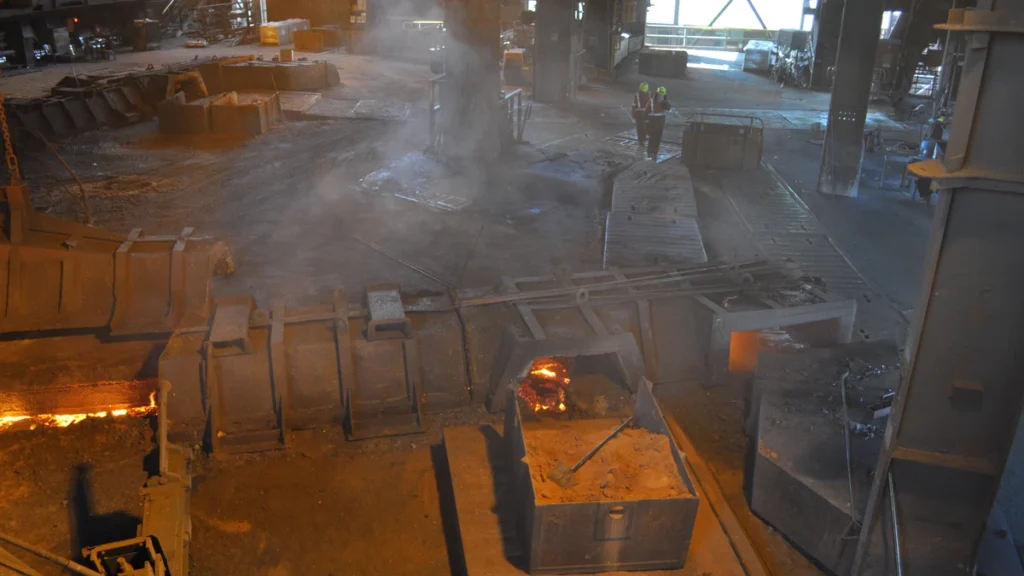
The Whyalla ironworks cast house in 2014
The Whyalla ironworks cast house in 2014
The blast furnace at the heart of the Whyalla steelworks in South Australia will not be restarted. Administrators KordaMentha told workers on 14 September that the 60-year-old furnace, offline since April, could not be saved, and that about 500 employees and 100 labour-hire (agency) workers would lose their jobs as a result. The cuts take the business’s workforce from 1,700 to 1,200, according to ABC News.
For readers outside Australia, the scale matters. Whyalla is the country’s only producer of long steel products such as rail and structural sections, and when the federal and state governments stepped in last year they said it made 75% of Australia’s structural steel. The plant has been run since February 2025 by administrators, the insolvency practitioners appointed to manage a failed company, after the South Australian government took it out of the hands of former owner Sanjeev Gupta.
Why the Furnace Could Not Be Saved
The furnace was the start of the steelmaking chain: a coal-fired vessel that melted iron ore into liquid pig iron, which was then turned into steel. It stopped in April, and months of attempts to restart it failed. In July, three employees were treated for injuries suffered during those attempts, according to the ABC.
A letter to staff, seen by the ABC, set out the administrator’s conclusion: “It is no longer appropriate to place our people at risk in pursuit of a recovery that is no longer feasible.” KordaMentha partner Sebastian Hams was blunter about the equipment itself. “The blast furnace will now go completely cold,” he said, adding that even a controlled shutdown was impossible “because we literally can’t get enough air into it.”
The same letter said steelmaking would “cease” until “new steelworks assets are constructed using modern steelmaking technologies”. Whyalla’s mayor, Phill Stone, told ABC News Breakfast that the city had always known a new chapter was coming, but “we didn’t expect it quite so soon”.
What the Job Cuts Cost, and Who Pays
The redundancies are being funded by taxpayers. Premier Peter Malinauskas said paying workers their full entitlements would cost the state and federal governments between A$60 million and A$80 million (all figures in Australian dollars). On top of that, the two governments announced a A$10.2 million package for the workers affected.
KordaMentha has said its first option is redeployment within the business, then voluntary redundancy, and then compulsory redundancy. “We won’t be able to accommodate everyone,” Hams told workers at the site.
The final number may be higher. About 200 “embedded contractors”, employed by outside firms but working at the steelworks and its associated mines and port, face an uncertain future, which could take the initial job losses to around 800. Hams called that “probably a fair number but it’s hard to say”, while Malinauskas said it was necessary to “exercise a degree of caution” because some contractors had work elsewhere.
Union officials described the mood as grim but not defeated. Shane Karger of the Australian Workers’ Union said it was “not a great day” and that there would be “some hard roads ahead”, but called the promise of full entitlements a “massive relief”. Steve McMillan, the local representative of the Australian Manufacturing Workers’ Union, told InDaily that many people had worked at the plant for more than 30 years, and “it’s the end of an era”.
The Rolling Mill Keeps Running on Imported Steel
Closing the furnace does not close the site. The rolling mill, which shapes semi-finished steel into rail and structural products, will keep operating, but it now depends on steel made elsewhere. Treasurer Tom Koutsantonis confirmed the plant would receive steel “blooms”, semi-finished blocks ready for rolling, InDaily reported. “It sounds ridiculous, but we will be bringing steel in so that the steel mill can continue,” Stone told the ABC.
That arrangement is expected to last years rather than months. Any buyer will need to build new steelmaking capacity, most likely an electric arc furnace, a technology that uses electricity rather than coal to melt scrap steel. Experts quoted by the ABC put the gap at two to four years. Journalist Paul Barry, whose book The Big Steal chronicles the unravelling of Gupta’s business empire, told the ABC he expected it to take “three years at least”.
Two Bidders and a Right of Last Offer
The sale is the next test. Two bidders remain in the running. Jindal Steel International told InDaily in July that it planned to build an electric arc furnace, and M Resources, owned by Australian billionaire Matt Latimore, says it would partner with an “A-Team” to design and build a “low-emissions steel mill”. BlueScope Steel retains a right of last offer, a contractual right to make a final bid.
Malinauskas said on 13 September that the process remained on schedule. “We intend to finalise the sale and the transaction by the end of this year. We’re on track to do that,” he said. Koutsantonis has framed the choice as one of competence rather than price: “We’re doing a capability assessment, not an auction on who can pay us the most.”
Not everyone is convinced by the timetable. Barry noted that a sale “was supposed to happen by September and it’s not happened”, and said the city’s prospects depended on a deal arriving soon. “If the sale goes ahead in the next three months, I think Whyalla will have a future and I think it will make steel again,” he said.
The Bill So Far for Taxpayers
The furnace closure adds to a public commitment that began in February 2025, when Prime Minister Anthony Albanese and Malinauskas announced a A$2.4 billion package. It comprised A$100 million in immediate support, A$384 million to fund the steelworks’ operations during administration, and A$1.9 billion to invest alongside a new owner in upgrades and new infrastructure.
Barry estimated that about A$500 million had been spent since the site went into administration. Tom Venning, the local federal Liberal MP, questioned the value of that support now that jobs are going: “How can the government justify more than a billion dollars in taxpayer support when hundreds of workers are now staring down the barrel of redundancy?”
Koutsantonis argues the money is buying a different outcome from the last time the plant changed hands, when he said the banks running the administration wanted the highest bidder. “What we’re trying to do is recapitalise with government money to make sure we’re never here again,” he said.
What Happens Next for Whyalla
Whyalla, with about 21,000 residents, is South Australia’s fourth most populous city, and the steelworks has defined it for generations. Other employers are hiring: InDaily reported that jobs may be available with mining company BHP and construction supplier Hallett Group, while Stone said some families “may have to think about relocating”.
Stone also described the relief of finally knowing where things stand. “At least we can start moving forward,” he told InDaily, adding that some workers would be disappointed by the decision while others would say “thank goodness”.
Governments elsewhere are also putting public money straight into industrial capacity, as in Britain, where Nexeon raised £100m and half of it came from the state. For the Whyalla steelworks, the measure of that kind of backing will be simple: whether a new owner can have steel flowing from a new furnace within the two to four years experts expect, before the rolling mill’s dependence on imported blooms becomes the new normal.
About The Author


More Stories
Government Borrowing Overshot the OBR by £3.5bn in One Month
Is the Bank of England One Meeting Away From a Rate Rise?
Late Payment Doubled and Small Firms Reached for Credit Cards