
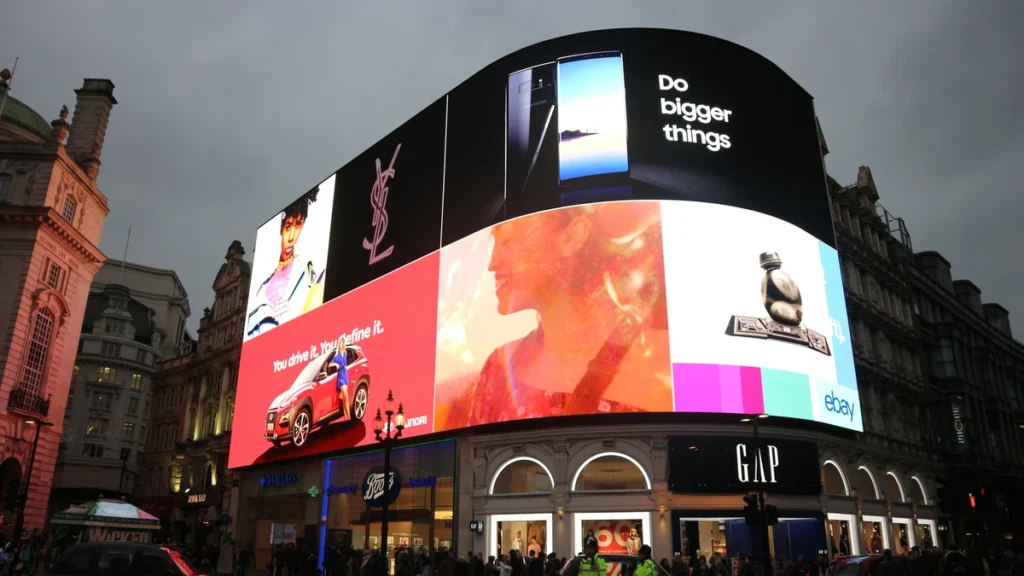
The advertising screens at Piccadilly Circus in central London.
The advertising screens at Piccadilly Circus in central London.
Gartner asked 401 senior marketers what share of their budget was going into artificial intelligence and got an answer of 15.3%. It then asked whether their organisation had the infrastructure to scale that investment, and 30% said yes. Those two figures, taken from the same survey, describe a spending decision running well ahead of the capability meant to carry it.
The finding comes from the annual CMO Spend Survey, reported by Marketing Dive from data Gartner shared with the publication. Seventy percent of respondents said becoming a leader in AI was a key goal for the year. Fewer than half that number said they were equipped to get there.
What the Gartner Numbers Actually Say
The survey was fielded between January and March, with 401 chief marketing officers and other senior marketing professionals in North America, Europe and the UK. The majority worked for organisations turning over more than $1bn a year, which matters when reading the percentages: these are not small firms improvising with a card and a chatbot subscription.
Within that group, AI took an average of 15.3% of the marketing budget. Organisations judged better equipped to scale the technology were spending materially more, at an average of 21.3%. The spread is worth pausing on. The firms with the governance and data foundations already in place are the ones increasing their allocation fastest, which widens the distance between them and everyone else rather than closing it.
Ewan McIntyre, vice president analyst and chief of research in the Gartner Marketing practice, put the risk directly in the press materials. “CMOs recognize AI’s potential as a force multiplier for growth, efficiency and transformation, but most marketing organizations are not yet built to capture that value,” he said. “The risk is that CMOs invest in AI tools faster than they build the data foundations, processes, governance and talent required to scale them.”
The Budget Has Not Moved
The context that makes the AI allocation awkward is that nothing else is growing to accommodate it. Marketing budgets came in at 7.8% of company revenue this year, against 7.7% last year. On a $1bn turnover that is a movement of roughly $1m in a line worth $78m, which is statistical noise rather than a decision.
Firms with optimised AI programmes did receive a larger share, averaging 8.9% of revenue. That is a meaningful premium, and it points at a finance conversation rather than a marketing one: boards appear more willing to fund a marketing function that can demonstrate it will use the money well.
Everyone else is funding AI out of a flat allocation, which means the 15.3% is not additional money. It is displaced money. Something in the existing plan is being stopped to pay for it, and the survey does not say what.
The pressure that creates shows up elsewhere in the same data. Fifty-six percent of CMOs did not believe their organisation had the budget required to execute its strategy for the year, and 54% said they did not have the resources. Those are majorities, reported by the people responsible for delivering the plan.
Where the Money Is Going Instead
The media market these budgets buy into is expanding faster than the budgets are. The IAB’s 2026 Outlook, drawn from more than 200 brands and agency buyers, forecasts US ad spend growth of 9.5% for the year, against 5.7% the year before. Stripping out the cyclical events, the underlying rate is 7.1% to 7.8%.
Those cyclical events are doing real work in the number. A Winter Olympics, a FIFA World Cup and US midterm elections are all landing in the same twelve months, which is why linear television’s decline is limited to 1.7% rather than something steeper.
Growth is concentrated in the channels that require the most operational machinery to run well. Social is forecast up 14.6%, connected television up 13.8% and commerce media up 12.1%. Each of those is bought programmatically, measured imperfectly and optimised continuously, which is precisely the work organisations are now trying to automate.
The Capability Gap in Plain Terms
Set the two studies side by side and the shape of the problem is clear. Media spend is growing at 9.5%, the fastest-growing channels are the most operationally demanding, marketing budgets are flat at 7.8% of revenue, and 70% of marketing leaders have named AI as the way to reconcile those three facts.
The 30% figure is what stands between that plan and its execution. Infrastructure here is not a software licence. It is the data foundations, the processes, the governance and the talent McIntyre listed, and none of those can be bought in a quarter or expensed against a campaign.
There is a familiar pattern in this. Investment frequently arrives before the capacity to convert it, and the gap shows up as a lag in the output figures rather than in the spending ones. UK factories showed the same profile earlier this year, hiring at a two-year high while output slowed. Money committed is the easy half of the measurement.
A related Gartner finding sharpens the talent side. Nearly two-thirds of marketers believe AI will change their jobs, but only 32% believe they need to update their skills. That is a wide gap between recognising a change and accepting a personal cost from it, and it sits directly underneath the governance and talent problem the survey identifies.
What Buyers Say They Will Do Next
The IAB survey suggests the direction is set regardless. Two-thirds of buyers, 66%, are focused on agentic AI for ad buying and campaign execution, and five of the top six areas of increased advertiser focus are tied to AI in some form. Seventy-three percent name AI-optimised content as a priority.
Measurement is being pulled along behind it. Cross-platform measurement is now a focus for 72% of buyers, up from 64% a year earlier, which is a rational response to spending more in channels that do not report on a common basis.
The objectives are shifting too. Customer acquisition remains the leading goal at 54%, but that is ten points down year on year, while driving repeat purchases has climbed to 25% from 13% in 2024. IAB executives have framed that as a rebalancing forced by rising acquisition costs and maturing first-party data, and it is the kind of shift that changes what a marketing team needs to be good at, not merely what it buys.
The friction is acknowledged in the same study. Changing consumer habits was named the top investment challenge by 44% of respondents, and understanding generative AI was named by 38%, up fourteen points on 2024. Confidence and comprehension are moving in opposite directions. Full findings are set out in the IAB’s announcement of the study.
The Risk of Buying Ahead of the Build
For a finance director reading the same numbers, the practical question is not whether to fund AI in marketing. It is what the 15.3% is currently displacing, and whether the organisation is in the 30% that can operate what it has bought.
Gartner’s own forecast adds a further wrinkle for anyone outsourcing the problem: it expects half of agencies’ proprietary AI platforms to be obsolete by 2029. Capability bought through a partner may not outlast the contract that procured it.
None of this argues for spending less. It argues that the reporting line has changed. A marketing budget that is 15.3% AI is a budget with a technology programme inside it, and technology programmes are judged on whether they reached production, not on whether they were funded. On the survey’s own numbers, seven in ten have not reached production yet.
About The Author





More Stories
LearnUpon Secured $50m Without Selling a Single Share
La Cordée Is Closing With $13 Million Owed and 210 Jobs Lost
Pensioners Would Carry Half the Private Health Insurance Rebate Cut