
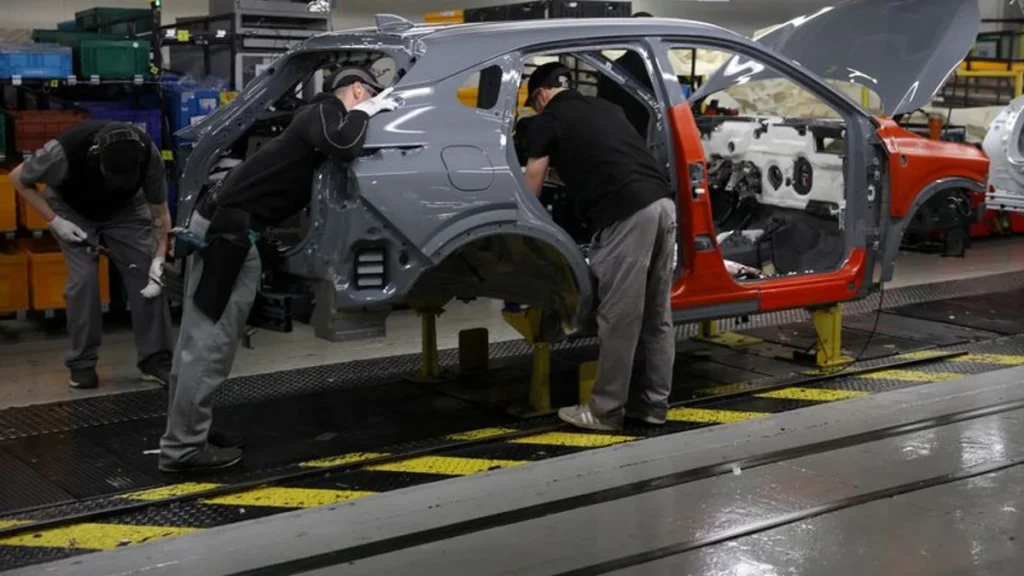
Two readings came out of the same survey on 1 September and they point in opposite directions. Growth in factory output slowed to its weakest since April. Hiring ran at its fastest pace in two years.
The headline S&P Global UK Manufacturing PMI came in at 51.7 for August, down from 51.9 in July and the lowest reading since March. It was, though, revised up from the flash estimate of 51.5 published while fieldwork was still open.
What a 51.7 Actually Tells You
The PMI is a diffusion index, not a growth rate. Fifty is the line at which the number of firms reporting improvement matches the number reporting deterioration. A reading of 51.7 means the balance tipped towards improvement, and that is all it means. It does not say by how much output rose, only that more purchasing managers saw it rise than saw it fall.
That distinction matters when a figure moves by two tenths of a point. The gap between 51.9 and 51.7 is not a measurable decline in production. It is a slightly smaller majority of firms reporting a better month, which is a far weaker claim than the phrase “five-month low” implies.
The revision is the more interesting detail. Flash estimates are built from responses received early in the survey window; the final number adds everyone who replied late. This time the final reading came in above the flash, which means the later responses were, on balance, more positive than the early ones. That is the opposite of what happens when a month is deteriorating as it goes on.
Hiring Into a Slowdown Is a Backlog Decision
Employment was the strongest component of the release. Factory payrolls grew at the fastest pace in two years, and the survey attributes it to three things: rising production requirements, improved intakes of new orders, and a determination to reduce backlogs of work.
The third of those is the one that resolves the apparent contradiction. A backlog is work that has already been sold. Hiring against a backlog is a materially different decision from hiring against a forecast, because the revenue is contracted rather than hoped for. It carries the risk that the work finishes and the headcount remains, but it does not carry the risk that the work never arrives.
It also explains how employment can accelerate while output growth decelerates. A manufacturer short of people produces less than its order book implies. The constraint sits on the shop floor rather than in the market, and the remedy is on the payroll. Output growth in that situation looks disappointing precisely because demand is running ahead of capacity, which is not the same problem as demand disappearing.
Set against the rest of the labour market, this is an unusual signal. Recruitment has been contracting almost everywhere else this year, with graduate vacancies nearly halved in a year. Factories adding staff at a two-year high are not following that pattern.
Investment Goods Up, Consumer Goods Down
Underneath the headline, the three broad categories of manufacturing moved separately. Investment goods, the machinery and equipment that other businesses buy, expanded at the fastest rate in two years. Intermediate goods, the components that feed other production, grew more slowly. Consumer goods output fell.
Read as a single sentence, that is a picture of businesses spending and households not. Companies are re-equipping. The people who would buy the finished articles are buying fewer of them.
The capital-spending signal deserves some care, because it does not sit comfortably alongside everything else. Construction orders fell by GBP 12bn in a quarter, which is investment of a different kind going the other way. Both can be true at once: a firm can buy a machine for an existing site while declining to commission a new building. Equipment is cheaper, faster to deploy and easier to reverse than a construction programme, and it is the sort of investment that survives a nervous year.
The consumer goods decline is the part with the least ambiguity. It is the same squeeze that shows up in retail volumes and in confidence surveys, arriving one step further back in the supply chain.
The Official Numbers Are Lumpier Than the Survey
The Office for National Statistics measures actual volumes rather than the direction of travel, and its picture is choppier. Production output showed no growth at all in Quarter 2, at 0.0% against the previous quarter, following 0.2% growth in Quarter 1. Manufacturing itself rose 1.0% over the quarter, offset by falls in electricity and gas, down 2.3%, and water supply and sewerage, down 3.7%.
Within manufacturing, eight of the thirteen subsectors grew across the quarter. The largest positive contributions came from basic pharmaceutical products, up 4.2%, and computer, electronic and optical products, up 3.0%.
Then look at the monthly series and the same sectors reverse. Production fell 0.2% in June, with manufacturing down 0.5%, and the largest negative contribution came from basic pharmaceutical products, down 5.1% after growing 4.3% in April and 0.2% in May.
A single subsector swinging four per cent up and five per cent down inside a quarter is enough to set the national figure on its own. That is not a flaw in the data; it is what a manufacturing base looks like when a small number of very large plants account for a large share of the volume. It is also why the survey and the official series can disagree without either being wrong. One counts how many firms saw a better month. The other measures how much came off the lines, and is dominated by whichever handful of sites happened to be running.
Prices Cooled Without the Causes Going Away
Cost pressure eased on both sides of the ledger. Input costs rose by the smallest amount since February, and output prices by the least since March.
The reasons given for prices rising at all, however, were the same ones as before: tariffs, geopolitical conflict and shipping disruption. None of those has been resolved. They are simply pushing less hard than they were.
This is a distinction that gets lost in coverage of inflation, and it is worth stating plainly. A slower rate of increase is still an increase. Official figures put factory gate prices up 3.1% over the year to July. A manufacturer whose input costs are rising more slowly than they were in February is still paying more than it paid in February, on top of everything it absorbed before that.
Optimism at a Six-Month High
Confidence about the year ahead climbed to a six-month high, which the survey attributes to stronger sales, reduced geopolitical uncertainty and lower trade tensions.
Optimism is a forecast rather than a measurement, and forecasts from within an industry tend to track the recent past more closely than their authors intend. Its value here is narrower than the headline suggests: it is corroborating evidence for the hiring number. Firms that expect a worse year do not add staff at a two-year high, and firms that add staff tend to report feeling better about the year. The two readings are not independent.
What the release describes, taken together, is a sector running slightly warm rather than one either accelerating or rolling over. Orders are improving from domestic and overseas customers. Backlogs are large enough to justify permanent hires. Investment goods are selling and consumer goods are not. Costs are still climbing, more slowly.
The number that will settle whether this is a soft patch or a turn is not the next PMI print. It is whether the employment component holds once the backlogs are cleared. Hiring to work through contracted orders is a bet on the work already won. Hiring after that is a bet on the work still to come, and nothing in this survey says the second bet has been placed yet.
About The Author






More Stories
LearnUpon Secured $50m Without Selling a Single Share
La Cordée Is Closing With $13 Million Owed and 210 Jobs Lost
Pensioners Would Carry Half the Private Health Insurance Rebate Cut