
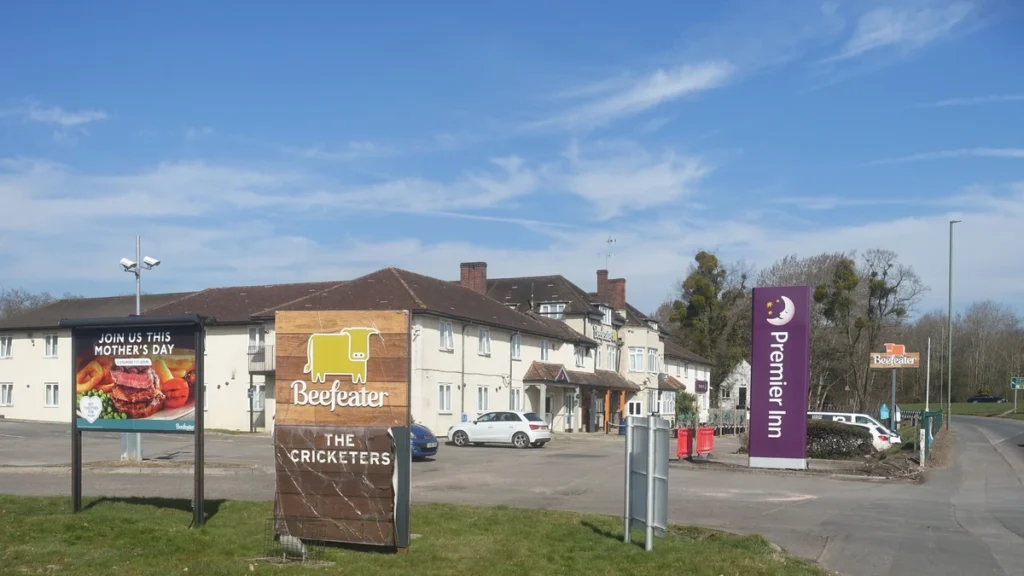
Three dates this month end a fifty-two-year-old restaurant chain, and the company doing it will be larger afterwards.
Whitbread confirmed in late July that its remaining branded restaurants would close in stages: Table Table, Cookhouse + Pub and the other brands after service on 3 September, Brewers Fayre on 7 September, and all 106 Beefeater sites on 10 September. The dates followed the completion of a staff consultation on proposals first announced in April.
What replaces them is not nothing. The restaurants become integrated food and drink operations inside Premier Inn hotels, and the estate change supports 3,600 hotel extension rooms in locations where the group sees strong accommodation demand.
Three Dates, Two Hundred Sites and 3,800 Roles
The staged timetable is a practical detail with a human edge to it. Staff at a Table Table site finish a week before their Beefeater colleagues, and the whole thing is over inside eight days.
Around 3,800 roles are going across the UK and Ireland, out of a workforce of about 30,000. Whitbread has said some staff will move into hotel roles and the new in-hotel restaurants, which is real but not equivalent: a kitchen brigade running a 150-cover carvery is not the same headcount as a breakfast and dinner service inside a Premier Inn.
The scale is what makes it notable rather than the shape. Hospitality closures are usually a long tail of individual sites; closing an entire national brand estate on a single day is rare, and 106 Beefeaters going dark simultaneously will be visible in a way that a gradual retreat would not have been.
Losing £160m of Sales to Gain £10m
The financial logic is the part worth reading twice.
Whitbread expects the exit to remove up to £160m of food and beverage sales, for a profit reduction of £10m once cost savings are counted. Those two numbers together describe restaurants that were turning over a great deal and contributing very little.
A branded roadside restaurant carries a full kitchen, a separate management structure, its own marketing and a menu proposition that has to compete with every pub and casual-dining chain nearby. An in-hotel breakfast and dinner service carries almost none of that, and its customers are already on the premises.
Sitting behind it is a five-year plan targeting £250m of cost efficiencies. Removing a low-margin division is a straightforward way to book a chunk of that, and it is the kind of decision that looks obvious once someone has made it and impossible before.
The Property Story Underneath the Restaurant One
The restructuring is not only about menus. Whitbread is offloading £1.5bn of freehold property and cutting the owned share of its estate from about half to 30%, alongside £2bn of shareholder returns planned by FY31.
That reframes the closures. A roadside Beefeater usually sits on a large plot next to a Premier Inn, and that plot is worth more as hotel rooms, as a sale, or as a smaller building with a car park attached than it is as a restaurant clearing a thin margin.
The 3,600 extension rooms come from exactly this arithmetic. A hotel room in a location with proven demand produces revenue with a fraction of the labour a restaurant needs, which is the whole argument for the switch in one sentence.
It also makes the group lighter. Selling freeholds converts a balance sheet into cash and returns, and it is a familiar move for a business under pressure to show what its assets are worth.
A Competitor Is Buying Some of the Sites
Not every site becomes a hotel room. Mitchells & Butlers agreed earlier this year to acquire a package of seven Whitbread sites, including former Beefeater and Brewers Fayre restaurants, which it intends to convert into Miller & Carter and Toby Carvery venues.
Seven out of roughly two hundred is a small number, and that is the interesting part. If these locations were straightforwardly good restaurant sites, a well-capitalised operator would have taken far more of them.
The reasonable reading is that the sites are fine and the format was the problem. Mitchells & Butlers is not buying a Beefeater; it is buying a building in a decent spot and putting a different proposition in it, one aimed at a higher spend per head. Whitbread’s judgement is that it could not make that transition itself while running a hotel business at the same time.
The wider trade has its own version of this squeeze, where independent brewers cannot get into 62% of their own local pubs because the routes to the customer are controlled by a handful of operators. The scale that makes a chain efficient is the same scale that makes it inflexible.
The Loyalty Scheme Went First
One small detail says more about the sequencing than the press statements do. The Beefeater Reward Club closed on 31 August, ten days before the restaurants it belonged to.
Members were told by letter, in wording that was careful to the point of understatement: “As you may have seen, we have recently announced changes to our business, which is resulting in the closure of our branded restaurants.”
Winding up a loyalty programme before the estate closes is standard practice, because points are a liability and an open scheme attached to a shutting business creates obligations nobody can honour. It is also the moment the decision becomes concrete for the customer, well ahead of a locked door.
A reward club is worth noticing for another reason. It is the part of a restaurant business that is genuinely hard to rebuild: a list of people who chose to come back. Whitbread is not transferring that relationship to Premier Inn, because a family who ate at a Beefeater once a month is not, by that fact, a hotel customer.
That is the quiet cost inside a clean strategic decision. The margin analysis is right and the property arithmetic is right, and the thing being given up is a habit that took decades to form and cannot be bought back at any price the plan contemplates. Whether that matters depends entirely on whether those diners were ever going to be worth more than the rooms replacing them, which is a question the accounts can answer only after the fact.
An Activist Holds 7%
None of this is happening in a quiet room. Corvex Management, which holds around 7% of Whitbread, is reported by the Financial Times to have told the board in May that a sale represented the only credible path to realising shareholder value.
Chief executive Dominic Paul’s framing answers that directly. He has described the exit from branded restaurants as part of becoming “a pure-play hotel business”, said the company is “executing each element at pace”, and argued the move will drive higher profits and returns in the UK.
Simplification is a defence as well as a strategy. A conglomerate trading below the sum of its parts invites a break-up argument; a single-business operator with a clean estate and a stated returns programme is harder to make that case against.
Group sales were £727m in the 13 weeks to 28 May, up 2% year on year, so this is restructuring from a position of modest growth rather than distress. That matters for how it should be read: it is a choice about where the returns are, not a rescue.
What a Pure-Play Bet Actually Risks
Becoming one thing is a real decision with a real downside.
A hotel-only Whitbread rises and falls with UK accommodation demand. The restaurants were low-margin, but they were also a second demand curve, drawing local customers who were never going to book a room. Remove them and every pound of revenue depends on occupancy.
Britain’s high street has been shedding formats like this steadily, and the same pressures show up across the sector, from a month of leadership changes across consumer businesses to the narrow trading conditions that make an average site unviable while a good one still works. Whitbread is not retreating from a failed business so much as declining to keep running a mediocre one.
For the towns involved the effect is more concrete than any of this. A Beefeater is often the only sit-down restaurant on a particular stretch of road, and when it closes on 10 September the nearest alternative may be several miles away. That is not a factor in a capital allocation decision, and it is the part local customers will notice first.
The bet is defensible on the numbers. £160m of sales that produced £10m of profit is a poor use of several thousand people and a great deal of land, and redeploying both into rooms with proven demand is a rational answer. Whether it is the right one depends on a single question that will not be answered this month: how reliable UK hotel occupancy proves to be once there is nothing else in the accounts to cushion it.
About The Author


More Stories
LearnUpon Secured $50m Without Selling a Single Share
La Cordée Is Closing With $13 Million Owed and 210 Jobs Lost
Pensioners Would Carry Half the Private Health Insurance Rebate Cut