
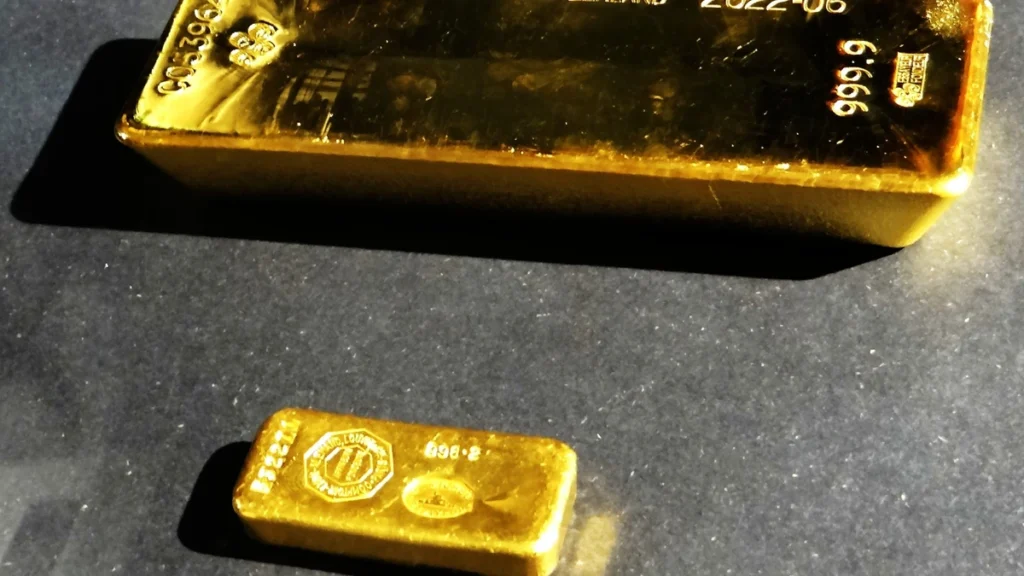
A gold bar and ingot held by the Banque de France
A gold bar and ingot held by the Banque de France
Spot gold traded at $4,026.55 an ounce on Tuesday, a modest gain of $9.47 on the day that did little to change the bigger picture. The gold price is about $1,570 below the 2026 high of $5,598.58 set in January, a fall of roughly 28% in nine months, and it spent part of last week below $4,000 for the first time since mid-July.
The timing matters. The US Federal Reserve opened a two-day policy meeting on Tuesday and announces its decision at 2pm Eastern time on Wednesday, which is 6pm in London. For a metal that pays no interest, the path of US rates is one of the biggest influences on price, and the market expects that path to keep rising.
Where the Gold Price Stands After a 28% Slide
The fall has been steep rather than steady. Gold was a runaway trade at the turn of the year: on 29 January its one-year gain stood at 95.6%, according to Yahoo Finance’s price tracking. December gold futures opened at $4,032.80 on Tuesday, 3.1% lower than a week earlier, 6.4% lower than a month earlier and 1.7% below its level a year ago.
Last week did the most recent damage. Gold lost about 4%, its worst weekly performance in roughly four months, and touched $3,975 on 23 October, the lowest level since July, according to Top1 Markets’ analysis of the move. The metal is now just 2% above its 2026 low of $3,942.52 and down 6.75% since 1 January, USAGOLD data show.
Part of last week’s selling had nothing to do with gold itself. An AI-led sell-off in equities forced some investors to sell gold to meet margin calls, the demand for extra collateral that brokers make when the value of a leveraged position falls. Gold can be sold quickly and in size, which made it an obvious source of cash when brokers came calling.
Why Higher Rates Weigh on a Metal That Pays No Interest
Gold produces no income. When interest rates rise, the return on cash and government bonds goes up, and the cost of holding an asset that yields nothing rises with it. That is why a rate cycle that turned upwards this year has been a major headwind.
The Fed raised its benchmark rate by a quarter of a percentage point in September, to a range of 3.75% to 4.00%. Futures markets, as tracked by the CME FedWatch tool, priced only about an 11% chance of a further rise at this week’s meeting, but about 82% for the December meeting. In other words, traders expect Wednesday’s statement to keep the door open rather than act immediately.
Oil is the complication. Brent crude climbed towards $112 a barrel after Houthi attacks on Saudi facilities, before easing on reports of Qatari mediation. Higher energy prices feed into inflation expectations, and higher expected inflation makes another Fed rise more likely. “Gold will need to establish a floor, as higher oil prices keep inflation risks in focus,” Suki Cooper, global head of commodities research at Standard Chartered, said in comments reported by Yahoo Finance. She identified $3,886 an ounce as technical support.
The US jobs market sends a mixed signal. Employers added only 29,000 jobs in September and unemployment stands at 4.2%, figures that would normally argue for caution on rates. The dollar, meanwhile, held near a one-week high on Tuesday, and a stronger dollar makes gold more expensive for buyers paying in other currencies.
The Paradox of Record Fund Holdings in a Falling Market
The selling in futures markets has not been matched by long-term investors, who have done the opposite. Global gold-backed exchange-traded funds, the listed funds that hold physical bullion on behalf of their shareholders, added 67.3 tonnes in September and lifted total holdings to a record 4,256 tonnes, according to World Gold Council data summarised by Money Metals Exchange. That happened in a month when the price fell by more than 8%.
The third quarter as a whole brought a record $31 billion of inflows, equal to 211 tonnes. Assets under management still slipped 7% in September to $574 billion, because a lower price shrinks the value of the gold already held.
The buying was broad. Funds in North America added 27.7 tonnes in September, worth about $4 billion, and the region’s $12 billion of third-quarter inflows was its first quarterly inflow of 2026. European funds added 21.7 tonnes, with UK-listed products taking in $2.2 billion in the month and a record $7.5 billion over the quarter. Asian funds added 16.2 tonnes, their third straight month of inflows, led by Chinese funds.
Central banks have also kept buying. They reported 39 tonnes of purchases in August and about 170 tonnes so far this year, Top1 Markets noted. Speculators have moved the other way: net long positions held by money managers on the COMEX futures exchange fell by 84 tonnes in September to 387 tonnes. The gap between those two groups, one buying physical metal for the long term and one trading futures on the next rate move, explains much of the volatility.
Silver Has Fallen Twice as Hard
If gold has disappointed, silver has collapsed. The silver spot price stood at $53.82 an ounce on Tuesday, about 56% below its 2026 high of $121.67 and only 1.5% above its yearly low of $53.01. It is down 24.83% since January, against gold’s fall of 6.75% over the same period, according to the USAGOLD daily market report.
The clearest way to see the gap is the gold to silver ratio, the number of ounces of silver that one ounce of gold will buy. It stood at 74.82 on Tuesday, up from roughly 60 at the start of the year. Put simply, an ounce of gold now buys about 14.5 more ounces of silver than it did in January.
Silver behaves partly as a precious metal and partly as an industrial input, used in electronics and solar panels, so it tends to amplify moves in gold in both directions. Platinum has also been weak, trading below $1,550 an ounce.
Who Feels a $4,000 Gold Price First
For businesses that buy gold as a raw material, from jewellers to electronics manufacturers, the metal now costs more than a quarter less than it did at the January peak. For producers the arithmetic runs the other way: every ounce a mine sells today fetches about $1,570 less than it would have at the high, which changes the economics of projects planned when prices were rising.
Holders of gold funds face a different question, which is how much volatility they signed up for. Gold’s long rally made it look like a one-way trade, and some commentators are pushing back on that view. “Buying high to hope for short-term higher is a tough strategy,” Darrell Fletcher, managing director of commodities at Bannockburn Capital Markets, told Yahoo Finance. Alex Tsepaev, chief strategy officer of B2PRIME Group, said gold “should not be seen as a driver of supercharged returns”, describing its role as primarily a stabiliser in a diversified portfolio.
The margin-call selling also shows how closely gold is now tied to the wider market mood. When the AI trade that has driven chip stocks wobbles, as it did last week, gold can be sold to raise cash rather than bought as a haven. Our report on why Micron cannot see the end of the memory shortage shows how far that trade now reaches; last week gold holders were caught in its slipstream.
Three Events That Decide the Next Move
The first is Wednesday’s Fed statement. A decision to hold is widely expected, so the market will read the language on December. A firmer signal would support the case for a hike and weigh on gold; any hint of patience could lift it. Top1 Markets sees moving averages at $4,044 and $4,080 capping recent bounces, with $4,100 to $4,150 possible on a dovish surprise.
The second arrives on Thursday, when the US publishes third-quarter GDP, with a consensus near 3.2% growth, and the personal consumption expenditures price index, known as PCE, which is the Fed’s preferred measure of inflation. Strong growth combined with sticky inflation would strengthen the case for higher rates.
The third is oil. If the reported Qatari mediation calms energy markets, inflation fears could ease and take some pressure off the gold price. If Brent heads back towards $112, the reverse applies. On the downside, analysts watch last week’s low of $3,975 and then $3,900, below which Top1 Markets sees a path towards $3,800. Ilya Spivak, head of global macro at Tastylive, described gold as “digesting within Friday’s range after the large drop”.
None of that changes the scale of what has already happened. In nine months gold has gone from a 95.6% one-year gain to trading 28% below its peak, while the funds that hold it have never owned more. Which of those two facts proves the better guide to the next nine months depends largely on decisions taken in Washington this week.
About The Author




More Stories
Capping Commercial Credit Card Fees Saves NZ Firms $40m on Paper
LearnUpon Secured $50m Without Selling a Single Share
La Cordée Is Closing With $13 Million Owed and 210 Jobs Lost