
Founder successions are usually announced from a position of weakness. A board loses patience, growth stalls, or the person who built the company runs out of the particular kind of energy that early-stage businesses demand. The announcement then arrives wrapped in language about a new chapter.
Mountain Warehouse has just done the opposite. Mark Neale, who started the outdoor retailer in 1997, is moving out of the chief executive role after 29 years, and the news, first reported by Retail Gazette, landed in the same week the company reported passing £500 million in annual sales for the first time.
Turnover rose 13.4% to £509.2 million in the year to 22 February, and operating profit climbed £13.9 million to £47.6 million. Marcus Ward, the chief financial and operating officer, takes over as chief executive on 1 September. Neale becomes executive chairman. He told The Times he was “still too young to retire”.
The timing is the message
A 13.4% increase in turnover is a strong year for any bricks-and-mortar retailer in the current market, and the profit movement is the more telling half. Operating profit rising by £13.9 million on roughly £60 million of additional revenue implies that a very large share of the incremental sales fell through to profit. That is what operational leverage looks like in a store estate that is already built and staffed.
Handing over at that point is a deliberate choice. The incoming chief executive inherits momentum rather than a turnaround, which removes the most common reason a founder succession fails: a new leader forced to make unpopular decisions in their first year while still establishing authority.
It also sets a demanding baseline. Ward’s first full year will be measured against a record one, and the company has publicly attached itself to a £1 billion revenue target. Going from £509 million to £1 billion is not an extension of the current trajectory. At 13.4% compound growth it takes more than five years, so the target implies either acquisition, a step change in international scale, or both.
Why promoting the finance chief matters
Ward is not an external appointment. He joined Mountain Warehouse as finance director in September 2007 and has spent 19 years at the business, serving as chief financial and operating officer for the past seven years and eight months.
That combined finance and operations remit is the relevant detail. A pure finance background can be a weak preparation for running a retailer, because the job is merchandising, property and people as much as it is capital allocation. Someone who has held both functions has already been accountable for store openings, supply chain and cost base, which is most of what a retail chief executive actually does day to day.
Internal promotion also protects something that is difficult to write down. A founder-led business accumulates a set of operating instincts about which categories to buy, how deep to discount and when to sign a lease. An outside hire spends a year learning those, and frequently discards some that were load-bearing. A colleague of 19 years has been in the room while they were formed.
The risk runs the other way. The same continuity that preserves good instincts preserves the unexamined ones, and a chief executive who has spent two decades inside one company may be slower to notice that a long-held assumption has stopped being true. That is a real cost, and it is usually the price of the stability being bought.
Opening 60 stores while the high street shrinks
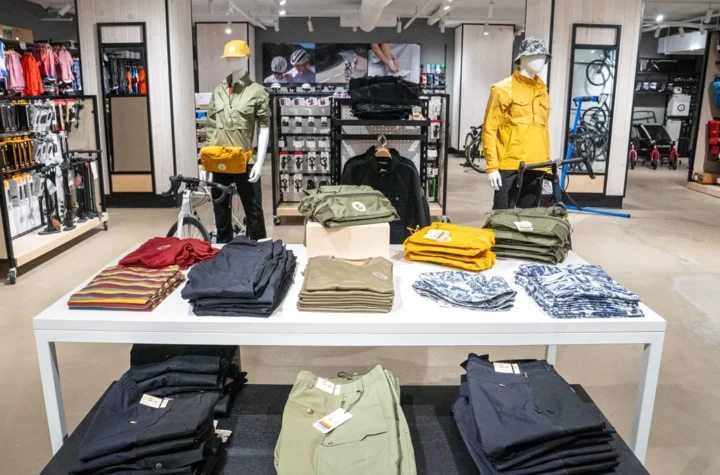
Mountain Warehouse trades from 434 stores across the UK, Europe, Canada, New Zealand and Australia, employing more than 4,400 people. Thirteen of those are Animal stores in the UK and seven are Eastern Mountain Sports in the United States. The plan for the current financial year is to open 60 more.
That is a conspicuous bet. The prevailing direction of travel in UK retail has been the other way for a decade, and the pressures are well documented: business rates, wage costs, and footfall that has never fully returned to its pre-2020 pattern. When we looked at the June figures, retail sales growth was leaning heavily on warm weather and promotions, which is not the foundation most chains would choose before signing 60 leases.
The counter-argument is that a contracting high street is exactly when space becomes cheap. Landlords with vacant units offer terms that were unavailable when the market was tight, and a retailer with cash and an established format can acquire well-located sites at rents that would have been impossible five years ago. Outdoor clothing is also a category that benefits from physical trial, since fit and weight are hard to judge online, which makes stores a genuine acquisition channel rather than a legacy cost.
Whether that reasoning holds depends entirely on rent. It is the difference between counter-cyclical discipline and simply adding fixed costs into a soft market.
What the executive chairman actually keeps
Neale is not leaving. As executive chairman he will focus on international expansion and on the two acquired brands: Animal, the Dorset surf-inspired label bought in 2021, and Eastern Mountain Sports, the American outdoor retailer acquired in 2024.
Read against the £1 billion target, that division of labour is coherent. Ward gets the established business, where the task is executing a known model well. Neale keeps the parts that are unproven, where founder-style judgement is more useful than process, and where failure would be survivable.
The arrangement carries the standard hazard of executive chairmanships. The person who founded the company retains a board title, an office and three decades of relationships, and a new chief executive can find that the formal transfer of authority has not been matched by an informal one. Whether this works will be visible in a year, in whether Ward makes a decision that Neale would not have made.
The hire nobody led with
The announcement carried a second appointment that received far less attention. Marsha Smith joins in mid-September as global retail director. She was Stores Director at Marks & Spencer from September 2024 to April 2026, and before that spent several years at Ikea, finishing as Country Deputy Retail Manager for the UK and Ireland.
For a business planning 60 openings across five countries, that is arguably the more operationally significant hire of the two. Running stores at M&S and Ikea scale is a specific discipline, and it is the capability a rapid multi-market rollout most often lacks. It suggests the expansion plan is being resourced rather than merely announced.
The advantage of not being listed
One structural fact makes this handover easier than most, and it is easy to miss because nobody involved has any reason to mention it. Mountain Warehouse is privately held.
A listed retailer announcing a founder’s departure alongside record results has to manage the market’s reading of both at once, and the market frequently decides that a founder leaving at a peak knows something it does not. That pressure shapes the timing: public-company successions tend to be announced either after a bad year, when the change is obviously a response, or with a long trailed handover designed to reassure. Neither is about what is best for the business.
A private company can simply do it when the operational logic says to. It can also install a founder as executive chairman without a governance code raising an objection, which would be a live issue on a public board, where combining a founder’s continuing authority with a new chief executive tends to attract scrutiny from institutional shareholders.
The trade-off is capital. A £1 billion revenue target reached through acquisition is materially harder without public equity to issue, so the growth has to be funded from operating cash flow, debt, or private capital. On £47.6 million of operating profit and a business that has just demonstrated it can convert incremental revenue efficiently, that is a credible base, but it constrains the pace. It is one reason the plan reads as 60 store openings rather than a transformative deal.
This is the same trade the wider market has been making, and the reason UK takeovers have been landing at premiums of up to 73%: private capital is competing hard for exactly this kind of profitable, cash-generative business.
What £1bn requires
Mountain Warehouse launched a new e-commerce platform in partnership with BigCommerce in April, which is the other half of a credible growth plan: an online estate that can serve five markets without a separate build for each.
The honest assessment is that this is a well-run private company handing over cleanly at a high point, with a successor who knows the business and a founder still in the building to work on the speculative parts. Very little about it is dramatic, which in founder succession is the point.
The pressures it is expanding into are real, and they are the same ones weighing on the rest of the sector, where confidence among smaller firms has been at record lows. Mountain Warehouse is betting that scale, cash and cheap space make those conditions an opportunity rather than a threat. The first evidence either way will be the 60 stores, and how much they cost to occupy.
About The Author




More Stories
LearnUpon Secured $50m Without Selling a Single Share
La Cordée Is Closing With $13 Million Owed and 210 Jobs Lost
Pensioners Would Carry Half the Private Health Insurance Rebate Cut