
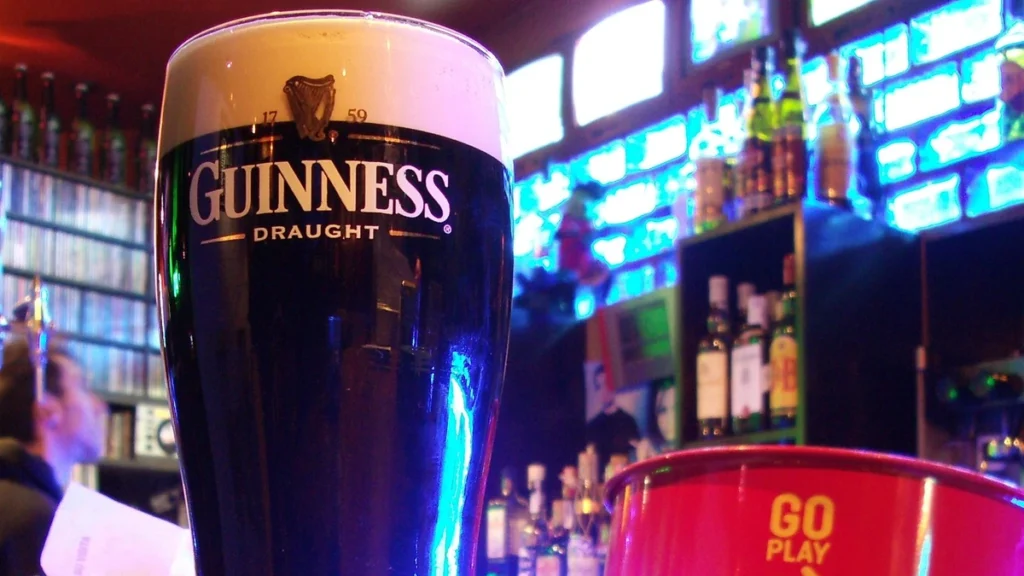
Diageo reported operating profit of $3,156 million for the year to 30 June, down 27.2%. Basic earnings per share fell 26.3%. The operating margin dropped 535 basis points to 16.1%.
The shares rose about 8.7% that day.
Both facts are accurate, and reconciling them is a useful exercise in reading a set of results, because the number the market traded on was not the number at the top of the statutory accounts.
The $2.5 Billion Between the Two Numbers
Alongside the reported figure, Diageo published an adjusted operating profit of $5,683 million, at a margin of 28.9%. The difference between that and the reported $3,156 million is a little over $2.5 billion.
That gap is exceptional items. The announcement sets out roughly $0.9 billion of restructuring charges, of which about $752 million relates to a new operating framework, and $1.5 billion of impairments covering hyperinflationary effects in Türkiye and brand write-downs including Don Papa rum.
The distinction matters. A restructuring charge is real money leaving the business, but it is money spent once to change the cost base. An impairment is not cash at all: it is an admission that an asset already on the balance sheet, usually a brand bought years earlier, is worth less than the carrying value.
Investors generally strip both out to see what the operating business did. Diageo’s answer on that basis was organic operating profit up 2%, or about 4.5% excluding Chinese white spirits, where government policy has hit the category.
Adjusted Numbers Deserve Suspicion, Not Dismissal
There is a reasonable objection here, and it is worth stating rather than skating past. Companies choose what counts as exceptional, and a business that reports a restructuring charge every year has arguably just found a way to move part of its ordinary cost base below the line.
Diageo’s own disclosure invites the question. The restructuring is described as a two-year programme, with savings arriving from fiscal 2027, which means another charge is coming next year before any of the benefit lands.
The test is whether the adjustments eventually stop and the two numbers converge. If reported and adjusted profit are still $2 billion apart in three years, the adjusted figure was never a temporary bridge. That is the thing to diarise, and it is more informative than either number in isolation.
There is a second layer of adjustment worth separating out, because it is a different kind of claim. “Organic” growth strips out acquisitions, disposals and currency movements, so that the figure describes the business as it stood in both years. That is a legitimate and standard adjustment. Comparing a company to itself after it has bought something tells you very little about whether the underlying operation improved.
The carve-out Diageo goes on to make is more debatable. It presents organic net sales as roughly flat rather than down 2%, and organic operating profit as up about 4.5% rather than 2%, once Chinese white spirits are excluded. The justification is that Chinese government policy hit the category, which is genuinely outside management’s control.
Whether to accept that depends on what you are trying to measure. If the question is how well management executed, excluding a policy shock is fair. If the question is what the company earned, it is not: the shareholder does not get to exclude it, and Chinese white spirits will still be in the business next year facing the same policy.
The practical approach is to hold both figures. The 2% organic operating profit growth is what happened. The 4.5% is what might have happened absent one identifiable external shock. Quoting only the second is advocacy; ignoring it entirely discards real information about the rest of the portfolio.
North America Is Most of the Problem
The regional split explains why the market was willing to look through the headline. Organic net sales fell 2% overall, but the decline was concentrated.
North America, comfortably Diageo’s largest profit pool, saw organic net sales fall 8.4% and organic operating profit fall 10.0%. Asia Pacific fell 6.3% and 5.4% respectively.
Sir Dave Lewis, in his first set of full-year results since becoming chief executive in January, put it plainly: the company is “focused on recovering our competitiveness in NAM”. That is unusually direct language for a results statement, and it identifies a competitiveness problem rather than a market one, which is a considerably harder thing for a chief executive to say.
It is also the correct diagnosis to make publicly if you intend to act on it. Blaming the American consumer would have been the easier line and would have committed him to nothing.
Where the Growth Actually Came From
The other four regions all grew, and two of them grew hard.
Africa delivered organic net sales up 13.3% and organic operating profit up 43.5%. Latin America and the Caribbean grew net sales 7.7% and operating profit 15.8%. Europe grew 3.4% and 15.7%.
Note the pattern in all three: operating profit grew several times faster than sales. That is operational leverage, and it is what a business looks like when volume is rising against a cost base that is already in place.
Africa growing profit at 43.5% will not offset a 10% decline in North America in absolute terms, because the bases are nowhere near comparable. But it does answer the question of whether the company can still grow anywhere, and the answer is that it grew in four regions out of five.
The Dividend Floor Is the Real Signal
The recommended full-year dividend was 50 cents, alongside a new policy: a payout ratio of 30% to 50%, with a stated minimum floor of 50 cents per year.
A floor is a much stronger commitment than a ratio. A ratio falls automatically when earnings fall, which protects the company and gives shareholders nothing to rely on. A floor does the opposite: it holds the payment steady through a bad year and puts the strain on the balance sheet instead.
Free cash flow of $3,211 million, up $463 million on the prior year, is what makes that promise affordable. Cash generation held up while reported profit collapsed, which is exactly the divergence you would expect when the charges are impairments rather than cash costs.
For a company whose shareholder base is heavily income-driven, committing to a floor in the year you write down $1.5 billion of assets is a deliberate signal about confidence. It is also the part of the announcement that would be most expensive to reverse.
What the 8.7% Does Not Mean
A rise of 8.7% in a day is a large move for a company of this size, and it is easy to read it as vindication. The longer view is less flattering.
Writing on the day, Harvey Jones noted that even after the jump the shares were 19% lower than a year earlier and down 55% over five years.
So the move was not the market deciding Diageo had returned to growth. It was the market deciding the results were better than what had already been priced into a stock that had more than halved. Those are very different conclusions, and only one of them says anything about the business.
This is a recurring problem with reading share reactions as verdicts. The percentage tells you the distance between the outcome and the expectation, not the quality of the outcome. A weak set of numbers can produce a rally, and a strong set can produce a fall, without either result being irrational.
What to Watch From Here
Three things will settle whether the reaction was justified.
First, whether North American organic net sales stop falling. An 8.4% decline in the largest region is the single number that most needs to change direction, and no amount of African growth substitutes for it.
Second, whether the promised savings actually appear in fiscal 2027 without a fresh restructuring charge alongside them. Programmes that deliver savings and new charges in the same breath tend to run indefinitely.
Third, whether the gap between reported and adjusted profit narrows. That is the cleanest available test of whether the exceptional items were genuinely exceptional.
None of those will be visible before the interim results. In the meantime, the honest summary of the year is that the operating business grew slightly, the accounts absorbed a large one-off hit, and the share price told you more about the previous year’s pessimism than about this one’s performance. It is the same trap as reading a weekly funding total that two deals happen to dominate, or a regional growth rate built on one round: the number is real, and it is describing something other than what it appears to describe.
About The Author





More Stories
LearnUpon Secured $50m Without Selling a Single Share
La Cordée Is Closing With $13 Million Owed and 210 Jobs Lost
Pensioners Would Carry Half the Private Health Insurance Rebate Cut