
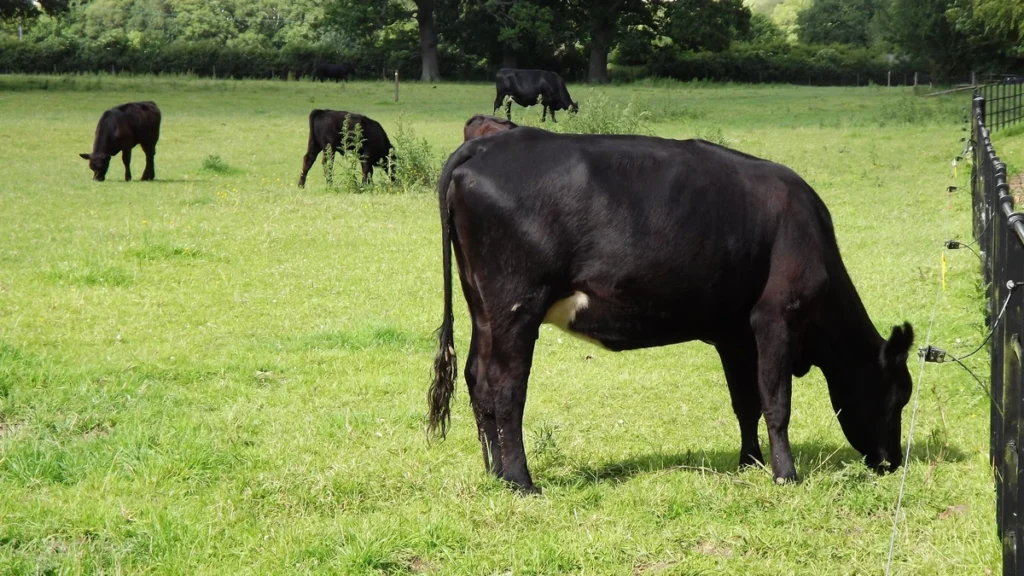
A company founded in Britain in 2018 to keep records for cattle has raised $27m, holds data on more than two million animals, and is now run from Texas.
Breedr’s Series B was led by Partech through its impact arm, with the returning investors LocalGlobe, via its Latitude growth fund, and Outsiders Fund, which led the Series A, taking part. Partech’s Arnaud Minvielle and Latitude’s Remus Brett join the board. The money funds expansion in Australia, New Zealand and the United States, alongside bringing more ranchers onto the platform and capturing more data per animal including genomics. Total funding reaches $46.6m.
The founder, Ian Wheal, is a fourth-generation rancher from Australia. That detail is not colour: it explains why the product exists in a form that farmers actually use, which is the thing most agricultural software gets wrong.
What the Platform Actually Does
Breedr builds a digital record for an individual animal and keeps it for the animal’s whole life.
Weight, health and breeding data go in from a smartphone app or from wearable devices, and the record follows the animal from birth to the supermarket shelf. At the point of sale, the same record becomes the listing: the animal trades on Breedr’s marketplace with its full performance history attached.
Wheal describes the loop directly: “Breedr is full circle beef. The data belongs to the farmer or rancher. The same digital record that follows an animal through its life also lets the producer trade it on our marketplace.”
The ownership point is the commercially important one. Farm data platforms have repeatedly failed because producers correctly suspected the value was flowing to the processor or the input supplier rather than to them. A record the farmer owns and can sell against is a different proposition, and it is why a rancher would bother entering the data at all.
Two Million Cattle and $500m of Trades
The scale numbers are what turned a record-keeping app into a fundable business.
More than two million cattle sit on the platform, and nearly $500m of livestock has been transacted through it during 2026. Revenue is up 230 times since 2020. Customers run from family-owned ranches to operators handling more than 100,000 cattle a year.
A 230-fold increase over six years is the kind of figure that usually indicates a very small starting base, and it probably does here. It is still the shape venture investors are looking for, and combined with $500m of throughput it describes a business with real volume rather than a pilot.
Two million animals is also enough to matter as a dataset. Breeding and weight-gain records at that scale are genuinely valuable for benchmarking, and they are the sort of asset that becomes more defensible the longer it accumulates.
Most of the Herd Is Still on Paper
The market case rests on a single unglamorous observation.
“Ranchers are being asked to produce more from a shrinking herd,” Wheal said, “and most of that herd is still managed on paper.”
Both halves matter. The US cattle herd entered 2026 at its lowest level since 1951, driven by higher production costs and drought, and this year’s calf crop is projected to be the smallest on record. That is why beef prices have risen through the supply chain. When the herd shrinks, the value of getting more from each animal rises, and that is precisely what better records deliver.
The paper point is the opportunity. An industry that still runs on notebooks has no incumbent software to displace, which is a rare position in 2026. The difficulty is that there is usually a reason such an industry has not been digitised, and in agriculture the reason is that the previous attempts asked farmers to do work that benefited someone else.
Those beef prices are visible at the other end of the chain. UK restaurant operators name beef among the ingredients rising faster than general inflation as their profits fell 44%, so a shrinking herd in Texas eventually shows up on a menu in Manchester.
The Fee Comes From the Transaction
The most instructive line in the round is the investor’s, because it explains what was actually bought.
Arnaud Minvielle, a general partner at Partech, said the team is “building the transaction layer for one of the world’s largest unmodernized markets, earning revenue every time an animal changes hands”.
Note where the revenue sits. This is not a subscription for software that helps you manage cattle; it is a take on the trade itself, with an embedded finance product alongside it. The management app is the reason the data exists, and the data is the reason the marketplace works.
That structure scales differently from software. A subscription business grows with the number of customers. A transaction business grows with the value flowing across it, which means Breedr’s revenue rises when cattle prices rise, and cattle prices are currently rising because the herd is shrinking.
It also explains the impact framing. A marketplace that pays producers more for animals with verified performance data is, if it works, redistributing margin towards the farmer, which is a legible thesis for an impact fund in a way that a farm software licence would not be.
Founded Here, Scaling There
For a British business audience the interesting fact is geographical.
Breedr was founded in the UK in 2018. It is now based in Austin, and the Series B funds expansion in Australia, New Zealand and the United States. The UK is not on that list.
There are perfectly good commercial reasons. The US cattle herd dwarfs the British one, the founder is Australian, and a marketplace business goes where the transaction volume is. No British policy failure is required to explain a livestock company moving to Texas.
It is still worth noticing as a pattern rather than an incident. The same month produced data showing inbound energy projects into the UK falling to 27 while France took 50, and the common thread is that companies with a choice about where to put their growth are increasingly not putting it here.
The counterweight is real too. British startups raised heavily this year, with UK startup funding doubling in the first half and taking 39% of Europe. The country is good at forming these companies. The open question is what share of them are still headquartered here at Series C.
An Impact Fund Led It, Not a Generalist
The identity of the lead investor is worth a paragraph, because it says something about how the round was underwritten.
Partech led through its impact arm rather than its main growth fund. Impact vehicles carry a dual mandate: a financial return, and a measurable outcome that the fund reports against. That changes which parts of a business are load-bearing in the investment case.
For Breedr the measurable outcome is legible enough. Verified performance data lets a producer prove the quality of an animal at sale rather than accepting the price the buyer offers on inspection, which shifts bargaining power towards the farm. Better records also reduce the waste of raising animals that underperform, which is where the environmental argument sits.
The reason this matters commercially is that impact capital is patient in a specific way. It tolerates a longer path to scale where a generalist growth fund would push for faster monetisation, and in an industry that has resisted digitisation for decades, the ability to move at the sector’s pace rather than the fund’s is a genuine advantage.
It carries a corresponding risk. A business that raises against an impact thesis has to keep delivering the outcome as well as the revenue, and the two can diverge. A marketplace under pressure to grow its take rate is under pressure to extract more from exactly the producers the impact case says it is helping. Nothing in this round suggests that tension is live yet, and it is the thing to watch in the next one.
What Would Make This Work
The test for Breedr is narrower than the headline number suggests.
It is not whether ranchers will use an app, because two million animals says some already do. It is whether enough of the trade moves onto the marketplace to make the transaction fee the main business, because that is what the valuation implies and what the investor described.
The risk is the one every marketplace faces in a relationship-driven industry. Cattle have been traded through auction barns and long-standing personal contacts for generations, and a platform has to be materially better, not marginally cheaper, to displace that. The performance record is the argument, and $500m of expected throughput suggests it is landing.
For anyone building in an unmodernised sector, the transferable lesson is the sequencing. Breedr did not sell software to farmers and hope a marketplace would follow. It gave producers a record they owned, waited until the record was worth something at the point of sale, and then took a fee on the sale. The order of those three steps is the whole business.
About The Author



More Stories
LearnUpon Secured $50m Without Selling a Single Share
La Cordée Is Closing With $13 Million Owed and 210 Jobs Lost
Pensioners Would Carry Half the Private Health Insurance Rebate Cut