
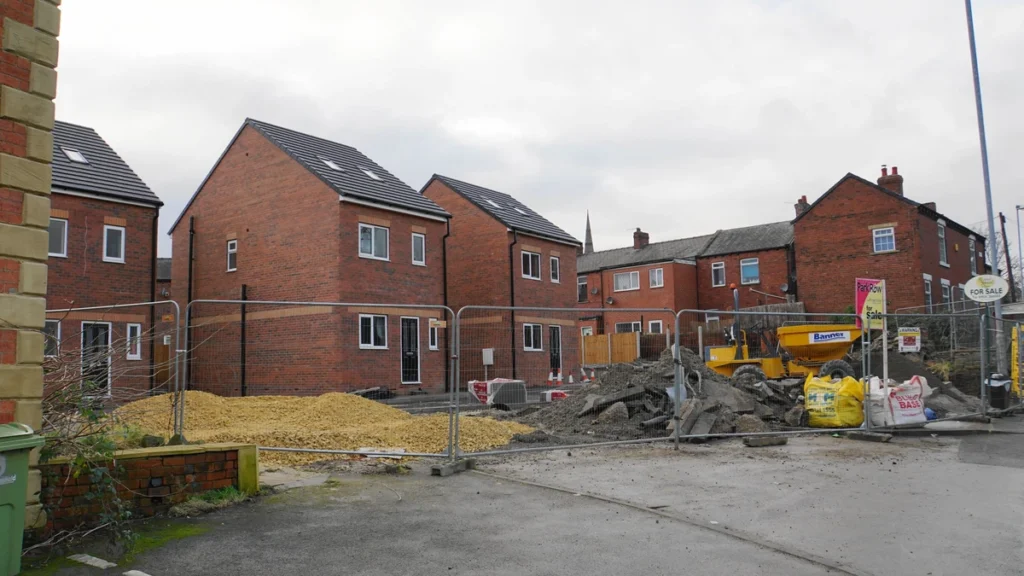
A housebuilder delivering fewer than 50 homes a year now sells between 0.15 and 0.25 homes from a site each week. At the lower end that is one sale every seven weeks.
The figures come from Land Matters: Removing Barriers to Housebuilding, published by Savills and the Land, Planning and Development Federation, which describes Britain’s smallest housebuilders as fighting for survival.
Annualised, that rate means a site sells about ten homes a year. For a developer whose entire output might be two or three sites, the whole business is turning over a couple of dozen units while carrying the land, the finance and the professional team for all of them.
Prices Flat, Costs Up 14%
The sales rate is the symptom. The arithmetic underneath it is the cause, and it is unusually clean.
Since September 2022, average house prices across England have risen by less than 1%. Over the same period construction costs have risen 14%, on the BCIS measure. A developer’s revenue has been effectively frozen while the cost of producing that revenue has gone up by a seventh.
The result shows up in the margin. The research puts the return on a typical three-bedroom home at around 13% of gross development value, against a typical requirement of 20%.
That gap is not a matter of ambition. Twenty per cent is roughly what a lender wants to see before advancing development finance, because it is the cushion that absorbs a cost overrun or a slower sale. A scheme penciling in 13% is a scheme that struggles to get funded, which is why sites with planning permission sit undeveloped.
It Is Not Only the Small Firms
The slowdown runs up the size curve, which matters for diagnosing the cause.
Firms delivering between 250 and 1,000 homes a year were achieving 0.4 to 0.5 sales per outlet per week in 2025, down from around 0.6 and above in 2022. Developers in the 500 to 1,000 band saw output from the average outlet fall from 33 homes a year in 2021 to 19 in 2025, a drop of about 40%.
If only the smallest builders were slowing, the explanation would be something specific to them: thinner management, weaker marketing, worse sites. The fact that mid-sized firms with professional sales operations are down by a similar proportion points at demand rather than capability.
The smallest firms are simply the least able to absorb it. A national builder carrying a slow outlet has fifty others; a developer with one site has no average to hide behind.
Why a Slow Sale Costs More Than It Looks
A halved sales rate does not halve the profit. It does something worse, and the mechanism is worth spelling out because it is invisible in the headline number.
Development finance accrues interest from drawdown until the units sell. A scheme underwritten to sell out in twelve months that takes twenty-four does not simply receive its money later; it pays a second year of interest on the whole facility, out of a margin that was already thin.
The research makes the same point about delayed cash receipts driving up interest costs and eroding the margins smaller developers depend on. In practice that is how a 13% scheme becomes a break-even one without a single cost estimate having been wrong.
There is a second-order effect too. A builder whose capital is trapped in unsold stock cannot start the next site, so the slowdown is self-propagating: this year’s slow sales are next year’s missing starts. That is visible in the wider data, where new construction orders fell by £1.2bn in a quarter.
From 40% of Homes to Under 10%
The long-run number is the one that should worry anyone planning housing supply.
SME builders delivered around 40% of new homes in the 1980s. Today they account for under 10% of the development pipeline. That is not a cyclical dip; it is a structural change in who builds the country’s houses, and it happened across four decades of successive market conditions.
The consequence is concentration. A supply chain that depends on a small number of large builders is one where national output tracks the board decisions of a handful of companies, and where the small and awkward sites that only a local developer would take on simply do not get built.
It also removes the part of the industry that responds fastest to local demand. A small builder can start a six-home site quickly; a plc allocates capital nationally and will not, which is a large part of why council direct housebuilding starts have fallen to a few hundred a quarter without anything filling the gap.
The Four Things the Sector Is Asking For
The report puts four specific requests to government, and they are notably concrete.
First, confirm and strengthen the new small and medium-sized sites category in the forthcoming NPPF without delay. Second, introduce a targeted equity loan scheme for first-time buyers, which the LPDF estimates could support up to 85,000 additional homes and nearly £24bn of GDP by March 2029. Third, allow greater flexibility on Section 106, including cascade mechanisms and wider acceptance of Discounted Market Sale tenure. Fourth, expand the National Housing Bank’s lending products for SMEs and provide up-front infrastructure funding.
Samuel Stafford, the LPDF’s managing director, framed it as a matter of holding course: “The government is right to be ambitious on housing, and right to reform the planning system, it should hold its nerve and stay the course.” His summary of the ask is shorter: “The country needs more builders, not fewer.”
Hamish Simmie, associate director at Savills Research, put the potential effect in terms of capacity, saying the changes “would have a material impact on the capacity of SME housebuilders and land promoters to operate” and would unlock the 1.1 million plots those operators control.
The South East Is Where It Bites Hardest
The pressure is not evenly distributed, and the geography is the opposite of what most people would guess.
The research identifies the South East as where the strain is greatest, on account of stretched affordability combined with the fall in SME sales rates. That is the region with the highest prices and, on any casual reading, the strongest demand.
The apparent contradiction resolves once affordability is separated from desire. Plenty of people want to buy in the South East. The binding constraint is the deposit and the mortgage multiple, and neither improves when prices stay flat while wages and rates do what they have been doing. A market can be simultaneously expensive and slow, and that combination is worse for a developer than a cheap one, because the land was bought at the expensive price.
It also explains why an equity loan scheme sits at the centre of the sector’s asks rather than a planning measure. Equity support acts directly on the deposit, which is the specific thing standing between a willing buyer and a completed sale in exactly the region where the most schemes are stalling.
For a developer the practical read is that a high-value region no longer implies a fast one. Absorption assumptions carried over from a market where South East units sold on release are the single most dangerous line in a current appraisal, because they are wrong in the place where the land cost the most to acquire.
Three of the Four Are About Demand
Read the recommendations together and something becomes obvious. Only the first is about planning.
The equity loan scheme, the Section 106 flexibility and the lending expansion all address the same thing from different angles: buyers who cannot complete, and developers who cannot fund the gap while they wait. That is a demand-side diagnosis from an industry that spends most of its lobbying effort on supply-side reform.
It fits the rest of the picture. Planning capacity is genuinely constrained, with councils short 2,660 planning officers and the gap widening, and fixing that is necessary. But a permission is only worth having if the homes sell, and at 0.15 sales a week they do not sell fast enough to fund the next application.
For anyone underwriting a small scheme now, the practical implication is to model the sales rate rather than inherit it. A 2021 absorption assumption applied to a 2026 site produces a finance cost that will not appear until the second year, by which point the equity is already committed. The builders that survive this period will be the ones that priced ten sales a year into the appraisal before they bought the land.
About The Author





More Stories
LearnUpon Secured $50m Without Selling a Single Share
La Cordée Is Closing With $13 Million Owed and 210 Jobs Lost
Pensioners Would Carry Half the Private Health Insurance Rebate Cut