
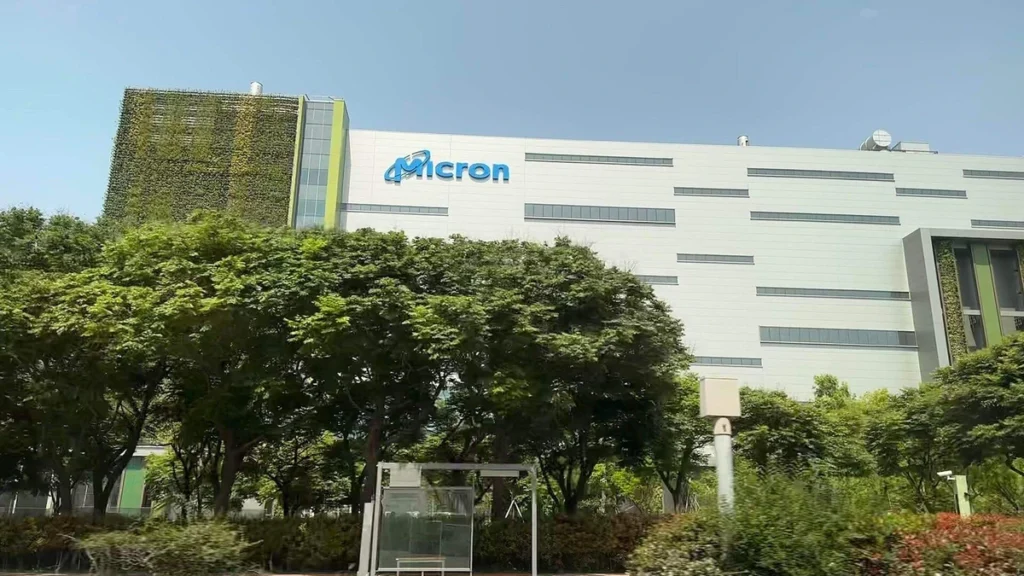
Micron Technology, the US memory maker based in Boise, Idaho, reported $54.2bn of revenue for its fiscal fourth quarter, nearly five times the $11.32bn it booked a year earlier. Its chief executive then said the part that matters most for every business that buys a laptop, a phone or a server: “We do not have line of sight to when supply and demand will return to balance.” The memory shortage that has pushed up the price of electronics over the past year is, on the maker’s own reading, not ending on any visible date.
That is a global story rather than an American one. Micron, SK Hynix and Samsung are the three leading makers of the high-bandwidth memory that AI servers depend on, and the same companies supply DRAM, the working memory inside computers, to device makers worldwide. The chips end up in data centres in Dublin, phones in Sydney and point-of-sale terminals in Toronto. When the three of them cannot keep up, the cost lands on device makers and, after them, on the companies that buy the devices.
The Numbers Behind Micron’s Record Quarter
The fiscal fourth-quarter figures, set out in Micron’s prepared remarks for the earnings call on 30 September, show how much of the growth came from price rather than volume. Revenue of $54.2bn was up 31% on the previous quarter and 379% on the year. DRAM brought in a record $39.8bn, or 73% of sales, with bit shipments up by a mid-single-digit percentage and prices up by a high-teens percentage in a single quarter. NAND, the flash storage in solid-state drives and phones, brought in $14.1bn as prices rose by roughly 30% against bit growth of about 10%.
Gross margin reached 87.0%, a level more usually associated with software than with manufacturing. Net income for the quarter was $37.7bn, against $3.2bn a year earlier, according to CNBC. For the full fiscal year, revenue came to $133.19bn, up from $37.38bn.
Guidance points the same way. Micron told investors to expect about $61.5bn of revenue in the current quarter, give or take $1.5bn, against a consensus of about $57bn, and its chief financial officer, Mark Murphy, said the first quarter should be the floor for gross margin in fiscal 2027. The company added that it expects a more moderate rate of price increases after that, which is a slower climb, not a fall.
Why Memory Prices Keep Rising
The cause is demand from artificial intelligence, and the arithmetic of supply. Data centre servers running AI models need far more memory per machine, including high-bandwidth memory (HBM), in which DRAM chips are stacked beside an AI processor so data reaches it fast enough. Micron said its data centre SSD revenue alone was nearly $10bn in the quarter, more than ten times the figure a year earlier.
Supply cannot follow quickly. Micron expects industry DRAM bit shipments to grow by roughly a low-20s percentage in both 2027 and 2028, with the industry supply-constrained in both years, and NAND shipments to grow by about a mid-20s percentage while also remaining constrained. The limiting factor is factory space. Adding output beyond what new manufacturing processes deliver requires new cleanrooms, and those take years to build.
Micron’s own timetable shows the lag. Its first new fab in Idaho is due to begin wafer output in mid-2027, the first New York fab expects initial output in 2030, and most of the extra construction spending planned for fiscal 2027 is aimed at cleanroom space from late 2028. The company plans about $25bn of capital spending in the first half of the fiscal year alone. CNBC reported that Micron is investing $250bn to build two new campuses for making HBM, while SK Hynix and Samsung are building new HBM factories in South Korea.
Customers Are Paying Cash to Secure Supply
The clearest sign of how tight the market has become is the way buyers are contracting. Micron has now signed 26 strategic customer agreements, multi-year take-or-pay contracts under which customers pay for committed volumes whether or not they take delivery. The company estimates they will account for more than 35% of its revenue through 2030, and some now run into 2031.
Customers have backed those agreements with $32bn of financial commitments, the vast majority of them cash deposits. Micron said any new agreements involving price are being negotiated at higher pricing based on current market conditions. On the earnings call, according to 24/7 Wall St, chief executive Sanjay Mehrotra said: “More than 75% of our output is already committed for 2027.” On HBM, he added: “A large part of the volume is already sold out for 2027… and the prices are much higher than 2026.”
For a buyer, the meaning is plain. Micron’s strategic customers are paying in advance to guarantee their memory, which leaves less uncommitted supply for everyone else and less room to bargain on price. A company that buys hardware in smaller quantities, without a contract of its own, is buying from what remains.
What It Means for Laptops, Phones and Servers
Micron’s view of the device market is unusually candid. It expects PC and mobile industry revenue to grow this calendar year, driven by the premium end of the market, despite potential double-digit declines in unit sales in both markets. In other words, fewer devices are being sold, each at a higher price, with more memory inside the expensive ones that carry new AI features. Micron’s mobile and client unit reported record revenue of $13.1bn, up 14% on the quarter, driven by higher pricing and partly offset by lower bit shipments.
The server market shows the same squeeze from the other side. Micron expects server unit growth in the high-teens percentage range in both 2026 and 2027, but said that growth is supported by a modestly lower rate of memory content growth than earlier expected, amid tight supply. Put simply, some machines are being built with less memory than their buyers would have chosen.
The effect has already reached shop shelves. CNBC reported that the shortage has led to a spike in memory costs and higher prices for consumer electronics such as Apple’s iPads and MacBooks, a pressure that sits on the desk of Apple’s new chief executive, whose start we covered when John Ternus began at $4tn where Cook began at $350bn.
How Businesses Can Plan Around a Tight Market
None of this tells a business when to buy, and no one can. What the filings do tell a finance team is that the memory shortage is likely to keep memory-heavy equipment expensive for longer than a normal price cycle would suggest, because the manufacturer with the best view of supply says it has no date for relief and is building capacity on a timetable measured in years.
Three practical consequences follow. Device budgets set on last year’s unit prices may need revisiting, particularly for high-specification laptops and workstations, where memory content is rising fastest. Refresh cycles that were planned on a fixed calendar may be worth checking against need, since an older machine that still does its job avoids buying at the top of a market. And server or cloud costs deserve a closer look at renewal, because data centre operators are paying more for the memory in their machines and have every reason to pass that on.
The picture differs by country only at the margins. Memory is sold into a single global market, so a firm in Auckland or Leeds faces the same component pressure as one in Chicago, with exchange rates and local distribution margins added on top.
The Risks the Optimistic Case Skips
Memory has always been a cyclical business, and sharp rises have historically been followed by sharp falls. The current cycle is unusual because so much demand is locked in by contracts, but it is not risk-free. 24/7 Wall St noted that heavy capital spending could pressure returns if demand cools, and that the bullish case would break if customers trimmed orders or Micron cut its outlook.
For now the market is reading the opposite way. Hendi Susanto of Gabelli Funds described the results to CNBC as “another strong beat and raise for Micron.” He added: “At this point, I have not heard any negative data points pointing to the memory cycle reversing toward a decline anytime soon for the foreseeable future.”
There are operational risks too. CNBC reported that hundreds of Micron staff in Taiwan had threatened to strike over pay, and Micron said it had increased incentive compensation for every employee in fiscal 2026. Labour disputes at rivals have ended in large bonuses, which adds to the industry’s cost base at a time when it is already spending heavily on new plant.
What to Watch Next
The next markers are close. Micron’s first-quarter results will show whether revenue lands inside its $60bn to $63bn guidance range, and the company has said it will step up share repurchases once it reaches its target cash level. More important for buyers is the pace of new capacity: Idaho output in mid-2027, more cleanroom space from late 2028, and New York in 2030.
Until those plants are running, the memory shortage looks set to remain a cost that every business pays somewhere, whether in the price of a laptop, the quote for a server or the monthly cloud bill. The company best placed to know has said it cannot see the end of it, and its customers are paying cash upfront on that basis.
About The Author





More Stories
The Ratchet Clause Keeping NZ Shop Rents High Is Now an Election Fight
Fewer Than 4% Opted Out of Ireland’s Auto-Enrolment Pension
Productivity Mega Deduction Halves Canada’s Tax on Investment