
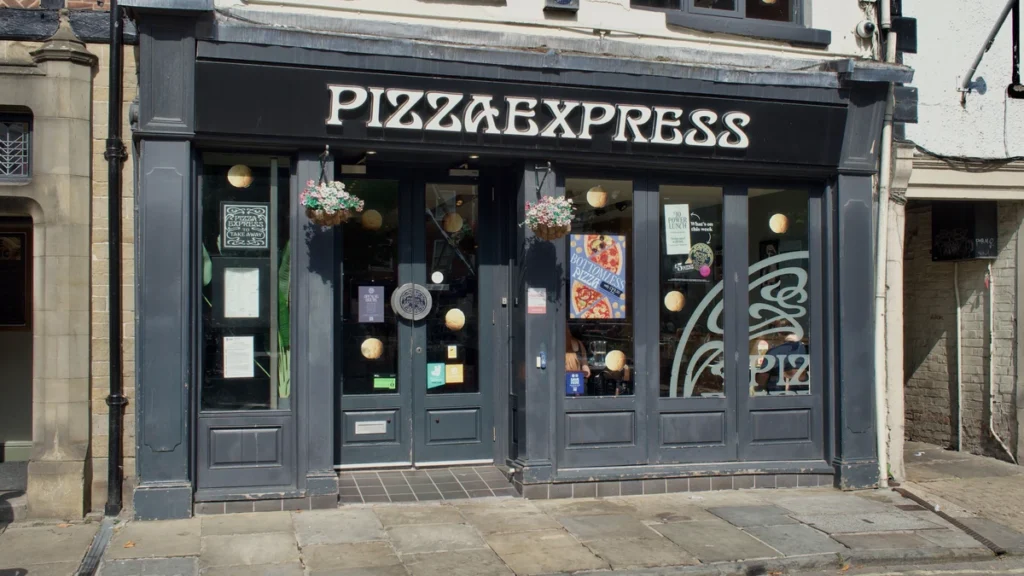
PizzaExpress closed 73 restaurants and went through a billion-pound debt restructuring before Paula MacKenzie took the chief executive job in May 2022. The chain had run through seven chief executives in eleven years. Four years later it reports 360 UK restaurants, 7,500 directly employed staff, and a stated ambition of 1,000 sites worldwide by 2030.
The gap between those two positions is the story, and the numbers behind it are more interesting than the ambition. In the first quarter of this year the company posted total sales of £112m against £108m a year earlier, with like-for-like sales up 5% and adjusted EBITDA of £12m, a rise of 30% on the £9m recorded in the same period a year before, according to figures reported by Restaurant. The quarter covered the thirteen weeks to 29 March.
What the Restructuring Actually Removed
The closures were finished before MacKenzie arrived. She took over roughly six months after the debt restructuring completed, which is an unusual position for an incoming chief executive: the painful decisions had been taken, and the job was to make the remaining estate work rather than to decide which parts of it to keep.
That sequencing matters for anyone reading the recovery. A chain that closes 73 sites and then reports like-for-like growth is not necessarily growing demand; it may simply have removed its weakest trading locations from the comparison. What separates the two readings is whether the surviving estate is itself improving, and on that point the company has a specific claim: around 80% of its high-street locations have been refurbished, and refurbished sites show a sales uplift of up to 10%.
The estate is also unusual in its ownership structure. All 360 UK restaurants are equity-owned rather than franchised, which means the company carries the full cost of every refurbishment and the full benefit of every uplift. Outside the UK the model inverts: around 90 restaurants operate internationally, with master franchisees running growth markets including India, Cyprus and Turkey, and direct ownership retained in Hong Kong and Dubai.
Revenue Rose, Profit Did Not
The most useful sentence in the company’s own account of the last four years is that revenues have increased steadily while profits have not yet followed. That is a deliberate outcome rather than a failure, and it is the part most turnaround coverage skips.
Full-year revenue for the last completed year came in at £440m, broadly flat, with adjusted EBITDA of £53m against £49m the year before, a rise of 6.3%. Flat revenue with rising EBITDA is a margin story: the same demand, converted more efficiently. The first quarter then delivered both, with sales and EBITDA moving together.
What sits between EBITDA and profit is the investment programme. The refurbishment of four-fifths of the high-street estate, the digital infrastructure, and the technical staff hired to run it are all real cash. So is the debt. In May last year the group reduced its borrowings to £280m, extended the maturity on its senior secured notes to September 2029 and pushed a £30m revolving credit facility out to March 2029. That combination buys time, and time is what an investment-led recovery needs.
The Loyalty Scheme Is the Quiet Asset
PizzaExpress reported four million loyalty scheme members as of last year, run through an app that also handles table booking. For a casual dining business that is a substantial first-party dataset, and it is the sort of asset that does not appear on a balance sheet but changes how a company prices, schedules and forecasts.
The company frames its reach in simpler terms, claiming that a quarter of UK adults eat in one of its restaurants at least once a year. Whether or not that figure is comfortable for a business that recently shut 73 sites, it describes a brand with distribution rather than a brand with a following, and those require different strategies. Distribution decays quietly. A loyalty scheme is one of the few instruments that measures the decay before the sales line does.
MacKenzie’s background is finance rather than food. She trained as a chartered accountant at EY, became head of commercial finance at Innocent Drinks at 27, and moved through KFC as supply chain director, chief development officer, chief financial officer, chief marketing officer and eventually UK managing director. The refurbishment-and-data emphasis reads as consistent with that route.
What a Turnaround Chief Executive Actually Does First
Speaking to Business Leader about her turnaround playbook, MacKenzie described the opening phase as diagnostic rather than decisive: “The first weeks and months, I’m listening, listening, listening, to get a super-sharp diagnosis.” She has also said that “‘good enough’ is good enough for the organisation to get going”, and describes the job now as being “like an air-traffic controller”.
Those are not decorative quotes. A business that has cycled through seven chief executives in eleven years has usually been reorganised repeatedly, and each reorganisation costs momentum. A stated preference for a good-enough decision taken quickly over a perfect one taken late is a direct response to that pattern, and it is measurable in the refurbishment rate.
On the quarter itself, MacKenzie said the momentum had been “exciting and rewarding for the full team that delivered it”, and noted that the business continues to outperform the wider casual dining market. That comparison is the one worth watching, because the sector has been contracting around it.
The Thousand-Site Number Is a Franchise Question
The target of 1,000 restaurants worldwide by 2030 cannot be met from the UK. With 360 equity-owned sites at home and around 90 abroad, the arithmetic requires roughly 550 additional restaurants in under four years, and an equity-owned model cannot fund that pace against £280m of debt.
The master franchisee structure already in place in India, Cyprus and Turkey is therefore the mechanism rather than a side note. Franchising transfers the capital cost to the operator and converts the company’s revenue into fees, which is a different business with a different margin profile and a different risk. MacKenzie has also named the United States as a market she wants, which is historically the graveyard of confident British casual dining brands.
The honest reading is that the UK business is being run for cash and the international business for growth, and that the 2030 figure is a franchising target wearing a restaurant target’s clothes. That is not a criticism. It is simply a different thing from what the headline number implies.
What to Watch in the Next Set of Numbers
Three measures will settle whether this is a recovery or a well-managed plateau. The first is whether like-for-like growth holds once the refurbishment programme finishes, because an uplift of up to 10% on refurbished sites stops being an engine when there are no unrefurbished sites left. The second is whether profit follows EBITDA, which depends entirely on how quickly the investment programme tapers.
The third is the international opening rate. A 1,000-site goal implies a run rate that would have to be visible well before 2030, and it has not appeared in the numbers yet. Casual dining has been a difficult sector to expand into for several years, and other operators have been reshaping estates rather than growing them, as with the hotel and restaurant trade-off in Whitbread’s decision to cut 3,800 jobs while adding 3,600 hotel rooms.
PizzaExpress has done the hard part, which is surviving a restructuring with a recognisable brand and a trading estate intact. What it has not yet done is demonstrate that the model can grow rather than recover. The next full-year accounts, due to be filed for the year to 31 December, will show whether the margin improvement of the first quarter carried through the rest of the year, and that is the number the sector will read.
About The Author




More Stories
Employer Health Cover Climbs 10% While Europe Averages 8%
John Ternus Begins at $4tn Where Cook Began at $350bn
Only 30% of CMOs Can Scale the AI Their Marketing Budgets Are Buying