
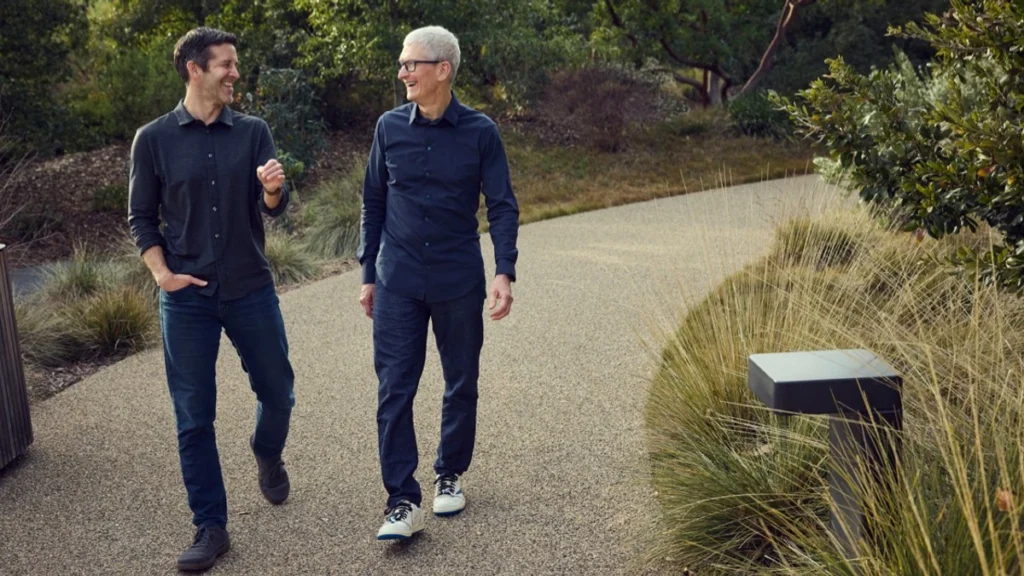
John Ternus, left, with Tim Cook at Apple Park
John Ternus, left, with Tim Cook at Apple Park
Apple changed chief executive on 1 September, and the arithmetic of the handover is worth stating plainly. Tim Cook took the job in 2011 with the company worth about $350bn. John Ternus took it with the company worth more than $4tn. That is the same business, the same product categories in most cases, and a valuation more than eleven times larger.
The transition was not a surprise. Apple announced it on 20 April, said the board had approved it unanimously, and gave Cook the summer to hand over. What makes it unusual is the second half of the arrangement: Cook is not leaving. He becomes executive chairman, and Apple says he will assist with certain aspects of the company, including engaging with policymakers around the world.
The Numbers Ternus Inherits
The figures in Apple’s own announcement set the scale of what changed hands. Revenue went from $108bn in the 2011 financial year to $416bn in 2025, close to a quadrupling. Net income and services followed: the services business alone now turns over more than $100bn a year, which on its own would place it inside the Fortune 40. Active devices passed 2.5 billion. Retail went past 500 stores, and Apple roughly doubled the number of countries with a store in it.
Headcount rose by more than 100,000 people over the same period. Apple also reports cutting its carbon footprint by more than 60 per cent against 2015 levels while revenue nearly doubled, a combination that is genuinely hard to engineer at that scale and which most large manufacturers have not matched.
What none of that settles is the operating question. A chief executive inheriting a $350bn company has room to make expensive mistakes. A chief executive inheriting a $4tn company has a market that prices in continued execution and reacts sharply to anything else. The margin for a learning year is narrower than it was in 2011, and that is the real difference between the two starting positions.
An Engineer, Not an Operator
The choice of successor says something about where Apple thinks its next decade of value sits. Cook came out of operations and supply chain; he was the person who rebuilt how Apple made and moved things, and the margin structure of the company still reflects that. John Ternus comes out of hardware engineering.
He is 51, the same age Cook was on taking the job, and Fortune records that he joined Apple’s product design team in 2001 after four years as a mechanical engineer at Virtual Research Systems, a headset maker, having taken a mechanical engineering degree at the University of Pennsylvania in 1997. He became vice president of hardware engineering in 2013 and senior vice president in 2021, taking a seat on the executive team. In that role he oversaw hardware across iPhone, Mac, iPad, Apple Watch and AirPods, and he led the introduction of the iPad and AirPods lines, both of which turned into multi-billion-dollar categories from nothing.
Cook’s assessment, in Apple’s announcement, was that “John Ternus has the mind of an engineer, the soul of an innovator, and the heart to lead with integrity and with honor”. Ternus, for his part, noted that he had “spent almost my entire career at Apple” and had “been lucky to have worked under Steve Jobs and to have had Tim Cook as my mentor”.
He had been the internal favourite for some time. Ternus took charge of iPhone hardware engineering in 2020 and moved to senior vice president in January 2021, and he was widely seen as the likeliest successor after chief operating officer Jeff Williams stepped back from operational duties in July 2025. Bloomberg’s Mark Gurman described him as “charismatic and well-regarded by Apple loyalists and trusted by Cook”. Apple, characteristically, promoted from inside rather than hiring a name from outside.
What an Executive Chairman Actually Does
The governance detail matters more than it usually would. Arthur Levinson had been Apple’s non-executive chairman for fifteen years. From 1 September he becomes lead independent director, which is the standard arrangement when a chairman role passes to a serving or former executive. Ternus joined the board on the same date.
An executive chairmanship is a real job with a real risk attached. Handled well, it keeps institutional memory and external relationships inside the company at a moment when a new chief executive needs both. Handled badly, it creates two answers to the same question. Commentary around the transition made this point directly: if Cook disagrees on strategic direction, that could affect Ternus’s ability to lead.
The specific brief Apple gave Cook is narrow enough to suggest the board has thought about it. Policymaker engagement is where Apple’s exposure is least about products and most about relationships built over years, which is precisely the kind of thing an outgoing chief executive can hold without touching operational decisions.
How Markets Read the First Day
The market response on 1 September was mild in the direction that matters. Apple stock moved higher during a session in which the S&P 500 fell 0.7 per cent, the Nasdaq Composite fell 1.0 per cent and the Dow Jones fell 0.7 per cent. On a trailing twelve-month basis the company was carrying revenue of $466.8bn and net income of $128.9bn, against a total shareholder return of more than 2,200 per cent across Cook’s tenure.
A single day is not a verdict, and nobody should read one session as an endorsement of a fifteen-year plan. What it does indicate is the absence of a surprise discount. Investors had four months to price the change and, on the evidence of the open, priced it as continuity. That is the most a board can ask of a succession it announced in advance.
The near-term operational drag is a memory shortage that is expected to squeeze margins and is generally described as transitory. Every hardware maker is exposed to the same component cycle, and it is a poor test of a new chief executive because it is not something a chief executive can fix.
What This Says About Planned Succession
Most large-company chief executive changes are reactive. A board loses patience, a set of results goes badly, or a chief executive leaves for another job and the succession plan turns out to be a slide rather than a person. Apple did the opposite: it named a successor four months ahead, kept the outgoing chief executive in post to hand over, and put both men on the board.
It is a pattern worth watching against how the rest of the market handles the same problem. DailyBusiness.News counted a single month of leadership changes hitting John Lewis, NEXT, ASOS and Puma, most of them announced with far less runway and read by the market as a response to trading rather than a plan.
The cost of the planned approach is that it can look slow, and shareholders in a company under pressure rarely want to wait four months for a named successor to arrive. The benefit is that the incoming chief executive starts with the board, the outgoing chief executive and the market already aligned on the decision.
The Test That Comes Next
Ternus’s first real judgement call will not be a product. It will be how much of the company he chooses to change while its financial performance gives him no obvious reason to change anything. That is the standard difficulty of inheriting a business at a peak, and it is what separates a caretaker from a successor.
He has one structural advantage that Cook did not: an installed base of more than 2.5 billion active devices, which is a distribution channel for anything Apple decides to put on them. Whether that becomes an advantage in artificial intelligence, where Apple has moved more slowly than its peers, is the question the next few product cycles will answer. An installed base is only leverage if there is something worth shipping to it.
The wider point for anyone running a business at any size is duller and more useful. Apple did not find a chief executive; it grew one over twenty-five years, promoted him through three levels of the same function, announced the change with four months’ notice and kept the person he is replacing available. None of that requires a $4tn balance sheet. It requires deciding, well before it is urgent, who is next.
About The Author





More Stories
Only 30% of CMOs Can Scale the AI Their Marketing Budgets Are Buying
UK House Prices Rose 2% and London Fell for a Tenth Month
Trusted Payments Holds 10% in Escrow Until You Sign Off