
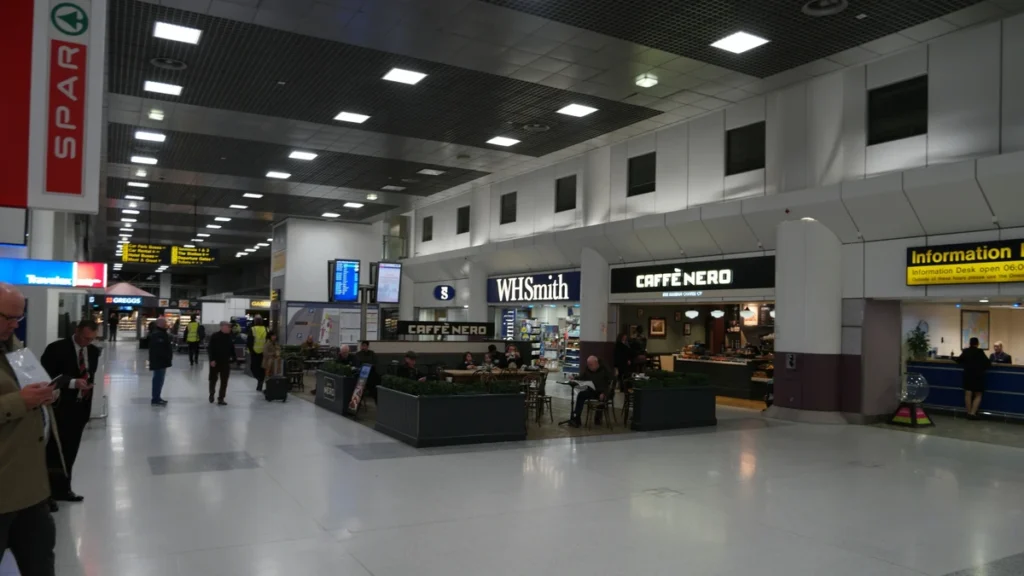
The most useful sentence in Manchester Airports Group’s breach notice is the one that gives no number. An unauthorised third party obtained “a quantity” of customer data from Manchester, Stansted and East Midlands, and the company has not said how much.
The figure in circulation, about 8.7 million customers, comes from press reporting rather than from MAG. Airways notes that The Guardian reported it and The Register had a MAG spokesperson confirm it as the current estimate, while the company’s public incident page still carries no figure at all.
What Was Taken
The records relate to car park, lounge and Fast Track bookings, along with sign-ups for in-airport Wi-Fi. The fields involved are email addresses, phone numbers, vehicle registrations and postcodes.
“Neither MAG nor the system accessed hold customers’ bank or payment details,” the company said in its statement. That is the reassuring line, and it is worth taking at face value while noticing what it does not cover.
A vehicle registration tied to a postcode, an email address and a phone number is not a payment record, but it is an unusually precise identity package. It tells a caller which car you drove, roughly where you live, and that you had business at a named airport on a known date. Phishing does not need card numbers to work; it needs credibility, and this dataset supplies it.
Six Things the Notice Does Not Say
Set against most corporate breach disclosures, the omissions here are unusually broad. MAG has not publicly identified the third party. It has not explained how access was gained. It has not named the affected system. It has not stated when the unauthorised access began.
Its notice also does not say whether the listed data fields are exhaustive, or whether every affected customer had each type of information exposed. And it gives no timetable for further updates or for restoring online booking management.
None of that is necessarily evasion. An active investigation with specialist advisers and regulators involved is a poor moment to speculate publicly about method. But it does mean the public record currently consists of a category of data, a set of field names, and a number the company itself has not published.
The Operational Story Is Genuinely Boring
“At no point has passenger safety or aviation security been compromised,” MAG said, adding that it “immediately contained the risk” and is working with specialist advisers and the relevant authorities.
The incident did not involve operational airport systems. Flights ran. Parking worked. Existing bookings stayed valid, and passengers with upcoming travel were told they need do nothing.
The single visible consequence was precautionary: the online Manage My Booking function was switched off. Anyone needing to change or cancel a booking within 72 hours had to telephone customer services instead, with MAG warning of longer waits than usual.
That distinction matters for how the sector reads this. It is not the September 2025 attack on a shared check-in and boarding supplier, which disrupted passenger processing at several European airports and produced delays and cancellations. This one touched the commercial database, not the runway.
The Number Is Big Because the Group Is Big
MAG describes itself as the UK’s largest airport group. Its three airports handled 66.3 million passengers in the year to March 2026: 32.3 million at Manchester, 30 million at Stansted and nearly four million at East Midlands.
Against that, 8.7 million customer records is a substantial slice but not an implausible one, particularly since car parking, lounges and Fast Track are exactly the products a frequent traveller buys repeatedly. It is worth stating plainly what the figure is not: it does not mean 8.7 million disrupted journeys, or 8.7 million people whose travel was affected. It is a count of customer records, most of them attached to a car park barrier rather than a boarding pass.
Car Parks Are a Data Business Now
The detail that should interest anyone running a large consumer operation is where in the group this happened. Not air traffic. Not baggage. Not check-in. It was car parking, lounges, Fast Track and Wi-Fi sign-ups.
Those are the products an airport sells directly to the public, and selling directly is what generates the identity data. An airline holds the passenger record; the airport holds the person who booked a parking space, gave a registration so a camera could read it, entered a postcode for billing, and handed over an email address to get online in the terminal. Each of those is collected for a mundane operational reason and none of them feels like sensitive information at the point of capture.
Aggregate them across a group handling 66.3 million passengers a year and the commercial arm ends up holding a richer identity dataset than the aviation arm ever does, under systems that are procured, integrated and secured to retail standards rather than aviation ones. The security boundary that matters commercially is not the one around the runway.
That is the transferable lesson, and it is not confined to airports. Any business that has added convenience products around a core service, pre-booking, loyalty, app sign-in, free Wi-Fi, has quietly built a second database that its risk register may still treat as marketing infrastructure. The Credit Protection Association’s daily briefing made the same point more bluntly, noting that the incident follows a series of high-profile attacks on major British organisations and underlines the risk carried by companies holding large volumes of customer information.
The Cost Lands After the Incident Closes
For a business audience the expensive part of a breach like this is rarely the intrusion. It is the long tail.
Eight point seven million people now have to treat unexpected contact about an airport booking as suspect. MAG has said it contacted affected customers directly and told them it would never make an unexpected request for payment-card details, banking information or passwords. That instruction is doing real work: the most likely follow-on harm is a convincing fraudulent message referencing a genuine car park booking.
There is a customer-service cost too, sitting in a call centre for as long as Manage My Booking stays offline, and a regulatory process that will run months past the point where the story stops being news.
It is the same shape as the wider pattern this desk has tracked, where four in ten UK businesses were breached and the median cost was nothing. The median is nothing because most incidents are trivial. The mean is carried by the few that look like this one, and by the handling costs rather than the theft itself.
What Would Actually Reassure
Three disclosures would change the picture, and none require naming the attacker.
The first is the entry route, at a level of detail sufficient to tell other operators whether a shared supplier, a credential, or an internet-facing system was involved. The second is the dwell time between access and detection, which is the single best proxy for how well the monitoring worked. The third is whether the field list is exhaustive, because a customer cannot judge their own exposure from a notice that declines to say.
Until then the honest summary is short. A large volume of contact and vehicle data left a major UK airport operator, the operator says payment data was never there to take, and almost everything else about how it happened remains unstated.
About The Author





More Stories
LearnUpon Secured $50m Without Selling a Single Share
La Cordée Is Closing With $13 Million Owed and 210 Jobs Lost
Pensioners Would Carry Half the Private Health Insurance Rebate Cut