
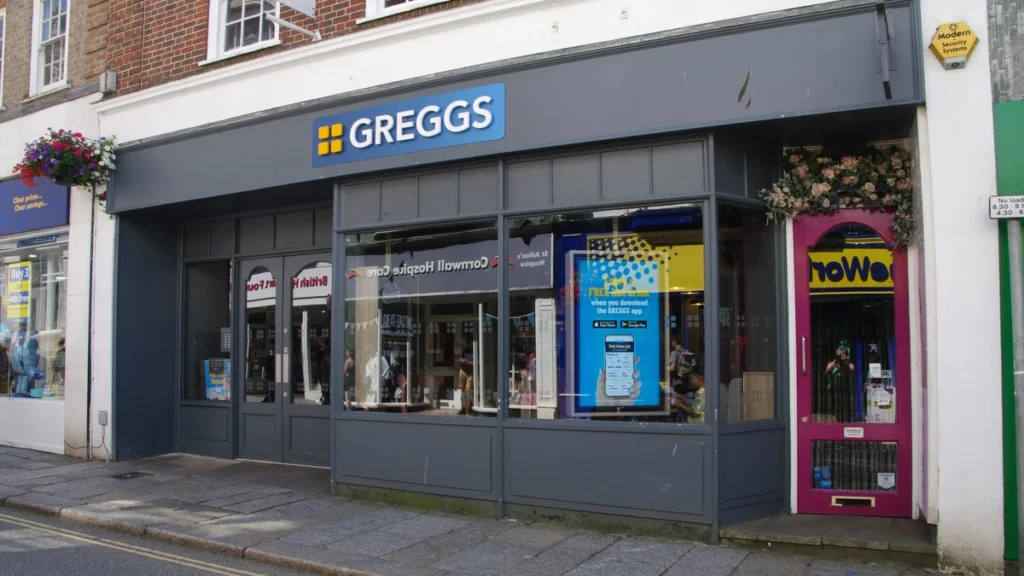
The most useful number in the Greggs half-year is not the profit percentage. It is 1.9%, and it belongs to somebody else: that is how far visits to the UK food-to-go market fell over the twelve months to June 2026.
Against that, Greggs increased its share of those visits by 0.3 percentage points to 8.7%, according to Circana’s CREST data cited in the company’s interim results for the 26 weeks to 27 June 2026. Growing share in a shrinking market is a harder trick than growing sales in a rising one, and it is the finding that survives every caveat below.
Share Rose in a Market That Shrank
Total sales for the half were £1,101.5 million, up 7.2% from £1,027.7 million. Operating profit rose 22.9% to £86.5 million and pre-tax profit rose 19.7% to £76.0 million. Diluted earnings per share came in at 54.9p against 45.3p.
The company also said card spending data confirmed it outperformed the wider eating and drinking out-of-home market over the period. That is a second, independent read on the same claim, and it matters because a share figure drawn from one panel is easier to argue with than two datasets pointing the same way.
The 22.9% Profit Jump Comes With an Asterisk
Greggs supplies the asterisk itself. Profit growth, the statement says, “reflects a soft comparator period together with growth in grocery business, strong cost control and the phasing of cost inflation”.
The comparator is worth spelling out, because the company published three years of figures side by side and the middle one is the low point. Operating profit was £75.8 million in the first half of 2024, fell to £70.4 million in 2025, and has now reached £86.5 million. Measured from 2024 rather than 2025, the two-year increase is 14.1%.
Sales over the same two years rose from £960.6 million to £1,101.5 million, an increase of 14.7%. Profit and sales have therefore grown at almost exactly the same rate across two years, which means the margin has recovered rather than expanded. Operating margin was 7.89% in the first half of 2024, 6.85% in 2025 and 7.85% now: back to where it was, and fractionally below.
None of that makes 22.9% wrong. It makes it a recovery figure rather than a step change, and the distinction matters for anyone extrapolating it into next year.
Only 2.1% of the Growth Came From Existing Shops
Like-for-like sales in company-managed shops grew 2.1%, and franchise shop system sales grew 1.3%. Total sales grew 7.2%.
The gap between those numbers is the story of how this business now grows. Roughly five percentage points of the total came from somewhere other than shops that were already open: estate expansion, the grocery retail channel and B2B partnership development. Existing shops are growing at a rate that would be described as steady in a good market and creditable in this one, but they are not the engine.
That has a practical consequence. Growth built on opening shops and adding channels requires continuous capital and continuous new sites; growth built on existing shops selling more does not. Greggs is doing the former, which is why the shop-opening programme and the distribution centres are not incidental detail.
The App Reached Nearly a Third of Transactions
The Greggs App was scanned in 31.0% of company-managed shop transactions, up from 25.7% a year earlier, and the company says app customers shop more frequently.
A loyalty scheme at that level of penetration stops being a marketing programme and becomes an information asset. Nearly a third of transactions are now attached to an identity, which is what makes menu decisions testable rather than instinctive. It is also cheap reach at a time when search alone is absorbing £4.6bn of UK ad spend in a quarter: an app already on the customer’s phone is not bid for at auction.
Menu development is where that reach gets used. New products in the half included Iced Matcha Lattes, an enhanced salad range and a new Chicken Roll, and the company credits menu development with supporting the like-for-like performance. Matcha in particular is a straightforward read of a consumer trend rather than an invention, which is the point: the range is following demand that already exists.
Three Ways to Buy Greggs Without Walking Into One
The estate reached 2,773 shops at 27 June after 34 net openings in the half, with 100 to 110 net openings expected across 2026 and at least 100 a year over the medium term. The stated long-term opportunity is at least 3,500 UK shops.
More interesting than the count is the widening of what counts as a Greggs. Four “bitesize Greggs” smaller-format shops have opened. A self-service coffee and food offer called Greggs Express is being trialled with a franchise partner in convenience retailing, with around ten further trials planned. The first international travel hub shop opened at Tenerife South Airport with franchise partner Lagardere Travel Retail.
Alongside that, three-quarters of company-managed shops now accept delivery orders through Just Eat and Uber Eats, and the grocery channel expanded with a Bake-at-Home launch in Tesco and a wider range in Iceland.
Each of those routes reaches a customer who was not going to walk past a shop. For a brand whose constraint has always been physical proximity, that is the more durable form of growth, and it is less capital-hungry than a new site.
Capital Spending Went Down, Not Up
The detail most likely to be skipped is that 2026 capital expenditure guidance was cut, from £200 million to around £180 million, while the opening programme stayed intact. The company expects strong operating cash generation to create capacity for additional shareholder returns.
Cost work is running alongside it: £11 million of structural cost savings targeted for 2026, of which £7 million has been delivered. New national distribution centres at Derby and Kettering will lift logistics capacity to 3,500 shops, which is the number the long-term estate ambition rests on.
One line is unusually candid. Restoring return on capital employed “to target of around 20%” remains a key area of focus, which is a plain acknowledgement that it currently sits below that level. A company expanding its estate while its returns on capital are below target is making a bet on future density, and saying so.
The interim dividend was held at 19.0p, unchanged for a third consecutive year. Against earnings per share of 54.9p that is a payout of about 35%, down from roughly 42% last year when earnings were lower. The dividend has not moved; the cover under it has.
An Unchanged Full-Year Outlook Is the Real Message
The board’s expectations for the full year are unchanged. After a half in which operating profit rose 22.9%, that is a deliberate piece of restraint, and it is consistent with management describing the comparator as soft rather than claiming a breakout.
Chief executive Roisin Currie framed it as continuity: Greggs “continued to outperform the market and has delivered an improved sales performance and strong cost control”, with the focus on “opening shops in more catchments and introducing convenient ways for customers to pick up Greggs favourites”.
The wider consumer backdrop remains awkward. Retail sales rose in June on warm weather and promotional activity, which is a fragile combination to build a second half on. A food-to-go market with falling visit numbers is not going to rescue anybody’s forecast.
What Greggs has, and most of its competitors do not, is a value position that works when customers are trading down rather than in spite of it. The half-year figures are a recovery to 2024 margins with share taken along the way. That is a good outcome. It is not, on the company’s own telling, a new trajectory, and the unchanged guidance says so more clearly than any percentage in the release.
About The Author


More Stories
LearnUpon Secured $50m Without Selling a Single Share
La Cordée Is Closing With $13 Million Owed and 210 Jobs Lost
Pensioners Would Carry Half the Private Health Insurance Rebate Cut