
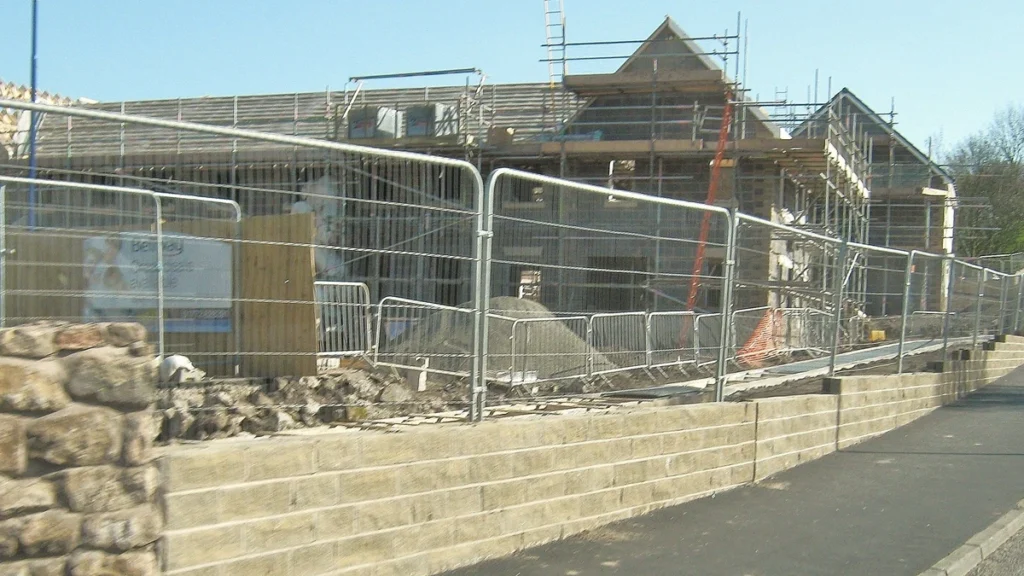
Local authorities in England started building 240 homes in the first three months of 2026.
Not 240 developments. Two hundred and forty houses and flats, across every council in the country, over a full quarter.
The figure comes from provisional ONS data published in BCIS’s analysis on 5 August, in a release whose headline was that housing starts had hit their highest level since 2023.
What the Rest of the Table Says
The headline is accurate. The UK recorded 40,770 housing starts in the first quarter, up 14.0% on the same quarter of 2025 and 7.2% on the previous quarter. England accounted for 84.5% of the total, with starts there up 18.0% year on year.
The composition of England’s roughly 34,470 starts is where it gets interesting:
Private enterprise started 27,640 homes, its highest quarterly total since 2023 and four in every five English starts. Housing associations started 6,590. Local authorities started 240.
Councils therefore accounted for about seven of every thousand homes begun in England, or 0.7%. If the sector had produced nothing at all, the quarterly total would have been almost indistinguishable.
A Three-Year High That Is Half the Old Level
The comparison doing the work in the headline deserves attention, because the release states it plainly: the last quarter to beat this one was the second quarter of 2023, which recorded 80,260 starts.
So the best quarter in nearly three years is 50.8% of the quarter it is being measured against. Rather than approaching the old level, output is at half of it, and is being reported as a recovery because nothing in between was better.
This is a general hazard of “highest since” framing. The phrase describes the position of a number within a run of recent observations, not its position against any standard that matters. A series that fell sharply and has stopped falling will produce “highest since” headlines for years while remaining far below where it started.
The release supplies the corrective in the same table. Starts are still 16.2% below the first quarter of 2019, and completions 16.7% below. Those comparisons are against a year that nobody regarded as a boom.
Councils Are Not the Whole Social Story
Reading the 240 as the totality of social housebuilding would be wrong, and the correction matters.
Housing associations started 6,590 homes in England in the quarter, twenty-seven times the local authority figure. Most social housing in Britain has been delivered by associations rather than councils for decades, following the large-scale transfers of council stock and the funding rules that followed. A council with no development capacity is the norm rather than the exception, and has been since long before this quarter.
Taken together, the social sector started 6,830 homes, about a fifth of England’s total. That is a real contribution and not a rounding error.
But it does not rescue the 240. Local authorities own land, hold housing waiting lists, and are the bodies that carry the statutory duty when households present as homeless. A development capability of essentially zero in the organisations holding that duty is a structural fact about how the sector works, whatever the associations manage alongside them.
One Sector Is Now Four Fifths of the Answer
The concentration in the figures is itself a risk, separate from the level.
When private enterprise accounts for four in five starts, national housing output becomes a function of one sector’s commercial judgement. Private developers build to sell, and they moderate output when demand softens or borrowing costs rise, which is a rational response for the individual firm and is exactly what shareholders expect of them.
In a system with substantial public and social development alongside, that moderation is partly offset, because those builders are responding to housing need and grant availability rather than to sales rates. Their output is not counter-cyclical by design, but it is driven by different signals, which is enough to smooth the total.
At 6,590 and 240, the other two sectors are not large enough to do that. Housing associations start roughly a quarter as many homes as private developers, and councils start a number that rounds to nothing. If private starts fall 20% in some future quarter, there is no part of the system positioned to make up the difference.
That is a fair description of the last decade. Output has tracked the private housing market closely, and the periods when it fell were the periods when that market weakened. The current 14% annual rise is welcome on the same logic in reverse, but it carries the same dependency: it is happening because private developers chose to build more, and it will stop when they choose otherwise.
Diversifying who builds is therefore not only a question of raising the total. It is what determines whether the total holds when conditions turn.
Starts and Completions Are Almost the Same Number
There were 39,890 completions in the quarter against 40,770 starts. The two figures are within about 900 of each other.
That relationship is worth more attention than either number alone. Starts feed the pipeline and completions drain it, so when they run level the stock of homes under construction is roughly stable. The sector is replacing what it finishes rather than building a backlog of work that will complete later.
For anyone hoping the 14% rise in starts signals a step change in delivery, this is the sobering line in the release. A genuine acceleration would show starts pulling clearly ahead of completions for several quarters, because that is the only way the number of homes actually finished can rise later.
The chief economist at BCIS, Dr David Crosthwaite, made the same point in more measured language, noting that there were more starts in the first quarter than in any quarter of 2025 “although growth in completions remained relatively subdued”.
Completions were also 19.1% down on the previous quarter, which is a large move. Some of that is seasonal, since the fourth quarter tends to be strong as developers close out their year, but a fall of that size means the annual rise of 2.7% rests on a low comparison rather than on momentum.
The Quarterly Numbers Move More Than the Industry Does
One caution applies to all of this, and it is the same caution that applies to a construction PMI that jumps sharply while still signalling contraction: the volatility of the series exceeds the volatility of the underlying activity.
Housebuilding data is collected largely through building control and gets revised. A quarter’s figure depends on when inspectors logged submissions as much as on when concrete was poured, and provisional numbers are exactly that. The 7.2% quarterly rise is well inside the range that revisions can move.
The annual comparison is sturdier, because it spans four quarters of the same collection process. A rise of 14.0% on the year is a real improvement, and it should be reported as one.
What it is not is evidence of a return to the previous level of output, and the same release contains the numbers that show why.
What Would Have to Change
Getting from 40,770 a quarter back toward 80,000 would require roughly a doubling, which no single policy lever delivers.
The composition points at where the constraint sits. Private developers are already at their strongest since 2023 and account for four in five starts, so they are not the part of the system that is idle. Housing associations, at 6,590, are constrained by grant funding and by the cost of maintaining and remediating the stock they already own. Local authorities, at 240, are barely in the market at all.
Any material increase therefore has to come either from private developers building considerably beyond their recent peak, or from rebuilding a public development capacity that has not existed at scale for a generation. The first depends on demand and land economics that policy influences only indirectly. The second is a matter of money and institutional capability, and takes years even where the will exists.
Neither is visible in this release. What the release shows is a sector that has stopped shrinking, at about half its recent peak, with the public part of it starting seven homes in every thousand.
About The Author





More Stories
LearnUpon Secured $50m Without Selling a Single Share
La Cordée Is Closing With $13 Million Owed and 210 Jobs Lost
Pensioners Would Carry Half the Private Health Insurance Rebate Cut